Poetry-Speak — The Re-Launch of Poet’s Quarterly

Lots of great summer reading!

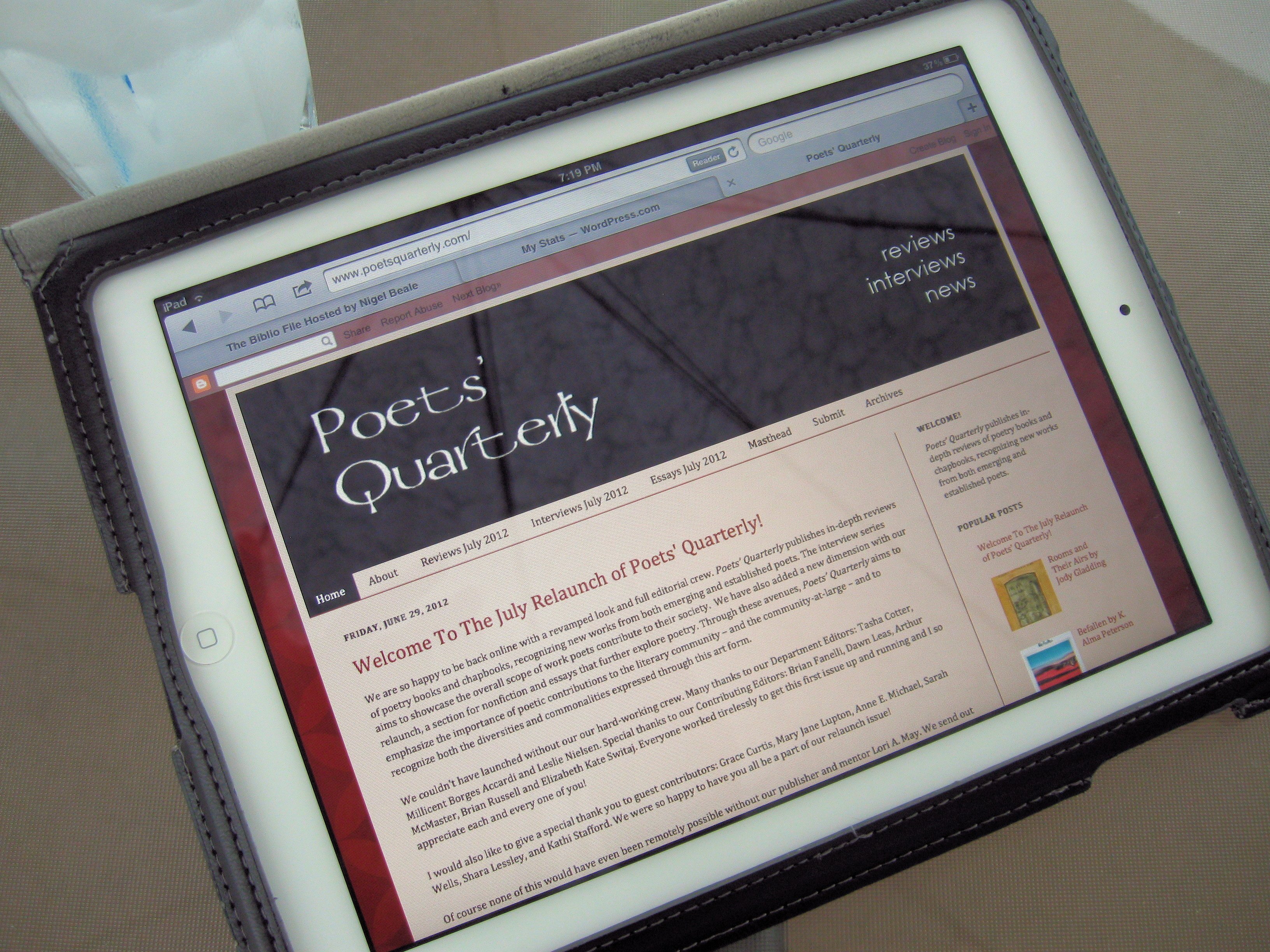
My essay, The Inexplicable Math of Good Poetry, in which I discusses the language used to describe poetry, is available in the most recent issue of Poet’s Quarterly.  Poet’s Quarterly is an online journal that publishes reviews, interviews and essays. The journal’s aim is to emphasize the importance of poetic contributions by poets and those who write about poetry, and to recognize both the diversities and commonalities expressed through this art form.

On June 29th, the journal re-launched after a brief hiatus with a full-house issue that will provide enough great reading to last the long-hot summer. I’ve just scratched the surface myself. It is packed full of reviews, interviews, and essays. Below is a complete roster of all the articles included in the summer issue. Congratulations to the distinguished editorial staff, Joan Hanna, Managing Editor, Tasha Cotter, Reviews Coordinator, Millicent Borges Accardi, Interviews Editor, Leslie Nielsen, Nonfiction/Blog Editor, Contributing Editors, Brian Fanelli, Dawn Leas, Arthur McMaster, Elizabeth Kate Switaj, and to Lori A. May, Founding Editor/Publisher for a successful re-launch.

Reviews:

–          The Pattern Maker’s Daughter by Sandee Gertz Umbach (Bottom Dog Press)   reviewed by Brian Fanelli

–          Onion Man by Kathryn Mockler (Tightrope Books) reviewed by Dawn Leas

–          The Art of the Sonnett, by Stephen Burt and David Mikics (Belknap Press) reviewed by Arthur McMaster

–          Ions by Jean Bleakney (Lagan Press) reviewed by Elizabeth Kate Switaj

–          The Outskirts of Karma by Alfred Encarnacion (Aquinas & Krone Publishing, LLC) reviewed by Ann E. Michael

–          The Fugitive Self: New and Selected Poems of John Wheatcroft by John Wheatcroft (Etruscan Press) reviewed by Mary Jane Lupton

Interviews:

–          “Professor, Poet, Fighter, Portuguese-American: An Interview with Carlos Matos” by Millicent Borges Accardi

–          “Turns Out We’re Doomed: A Conversation with Glenn Shaheen” by Brian Russell

–          “The Journey: An Interview with Laurie Ann Guerrero” by Kathi Stafford

–          “There and Back: An interview with Traci Brimhall & Sara Lessley”

Essays:

–          “The Inexplicable Math of Good Poetry” by yours truly (Grace Curtis)

–          “From Motown to Mos Def: The Musical Influences of Patricia Smith, Major Jackson, and Kevin Coval” by Brian Fanelli

–          “Grounded: Engaging the Spiritual In Poetry” by Sarah Wells

© 2010-2012 Grace Curtis

Posted in Poetry Events, Poetry Journals | Tagged , , | Leave a comment

Creating Collaborative Haiku

A while back, a good friend, poet, Joey Connelly and I thought it would be fun to collaborate on some haiku. We each wrote, five of the two parts of the haiku, dividing the poem as described by Tom Lowenstein, editor of the book that must be on every poet’s shelf, Classic Haiku. Classic Haiku is a gorgeous clothbound edition filled with traditional haiku from the great Japanese poets, Bashō, (c. 1644-94), Buson (1715-83), Issa (1762-1826), and Shiki (1867-1902). It is loaded with beautiful pictures, and it provides enlightening background on both the form and the poets. It even has a ribbon bookmark built into the binding.

Within this format, the haiku was generally divided also into two parts standing in contrast or reversal to each other.  A poem might start with a traditional image such as cherry blossom, full moon or dew, then re-focus to a “lower”, perhaps clashing, image.

We wrote five two-line parts, one with five syllables and the second with seven, as the initial, and perhaps, more commonly evoked images.  We also wrote five single, five syllable “lower” lines, that in traditional haiku, “let in descriptions of ordinary life”  often with comedic or absurd results. Our goal was to end up with ten poems in, more or less, traditional haiku form. In this video, poet Robert Hass, demonstrates this concept of an initial idea placed up against a clashing or “lower” line.

At the time I was reading Classic Haiku and was intrigued by the notion that, “In many great haiku, seasons and images are suffused with a philosophical mood that introduces a contrast, tension or incongruity into a holistic vision of existence.” Lowenstein tells us that Bashō once told his Zen teacher that a haiku was a description of what is happening at a particular “haiku moment”.

By presenting imagery that flashes quickly and vividly on the mind’s eye, each poem recreates a unique, dramatic scene that expresses emotion and a philosophical awe in the face of some aspect of the natural or social world.

It was this idea of creating the unique, dramatic scene that delivers its impact through contrast,  introducing incongruity into our holistic vision of existence, that I found especially intriguing; and nothing creates contrast like mashing together lines written by two different poets. We emailed our lines to each other, then created combinations by mixing and matching our lines. I tended to come up with more traditional nature or seasonal images and Joey generally supplied interesting non-traditional ideas.

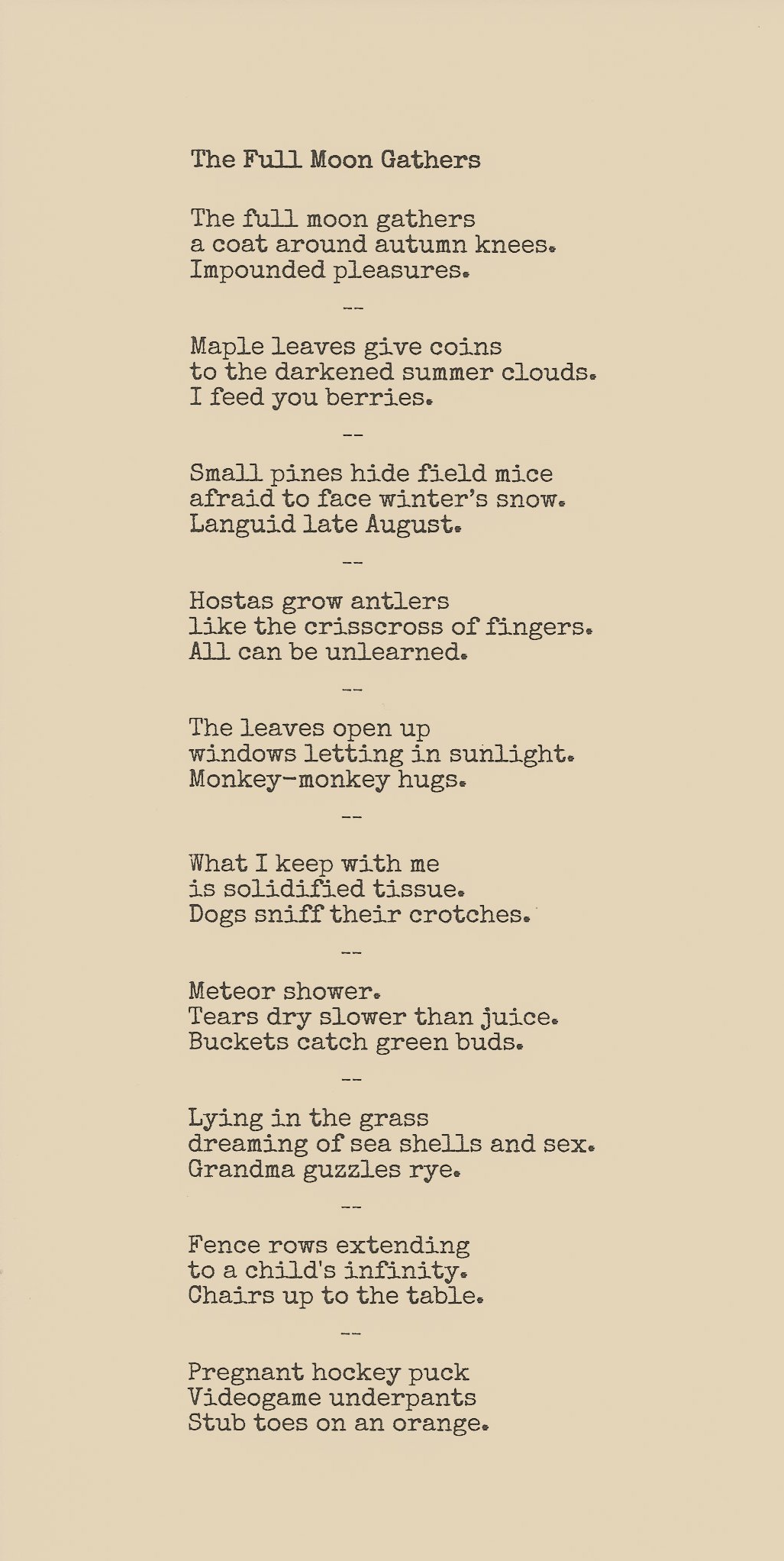
Following is the result of our collaboration—our shared haiku moments. We weren’t trying to create award winning poetry, but rather, we thought the exercise might yield some fascinating results. I’d love to hear your comments about our results, about haiku, or, about any experiences  you have had with collaborative poetry creation. The act of designing the collaboration and, then of the actual collaboration effort, such as the monumental undertaking by poets, Dean YoungChristopher MerrillMarvin BellTomaz SalamunSimone InguanezIstvan Laszlo Geher, and Ksenia Golubovich, that yielded the book, 7 Poets, 4 Days, 1 Book, offer both poets and readers interesting artistic possibilities.

Bio: Poet, Joey Connelly earned his MFA from Ashland University in 2010 and is Assistant Professor of English at Kentucky Wesleyan College.  His work has appeared or is forthcoming in The Rumpus, Peripheral Surveys, Medulla Review, Louisville Review, and others.  

© 2010-2012 Grace Curtis

Posted in Collaborative Poetry, Poetry, Poetry Readings, Uncategorized | Tagged , , , , , | 2 Comments

2013 Poetry Chapbook Contest Announced at Lettre Sauvage–A Letterpress Story

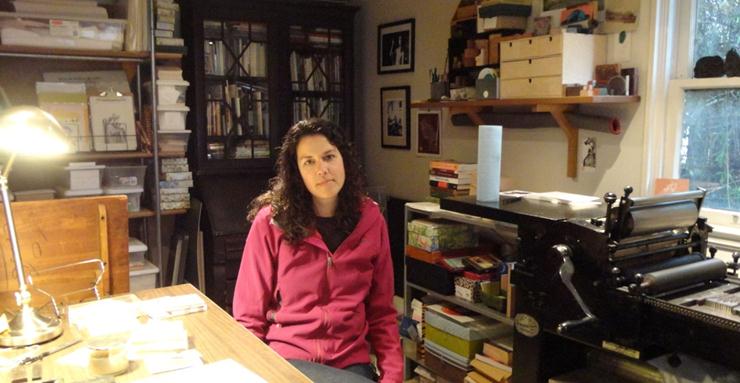
Fiona Leggett, (pictured here) owner, operator, and director of the Santa Paula, California based, letterpress studio, Lettre Sauvage, has recently announced that the press is sponsoring another chapbook contest for 2013. This is great news! As the 2010 winner with my collection, The Surly Bonds of EarthI can attest to the superb quality of the books produced by this small press. I feel honored to have a Lettre Sauvage letterpress chapbook with my name on it; any poet would. Each year they produce only a limited number of editions and broadsides. According to Fiona, contest submission information will soon be available on their website.

Before winning the chapbook prize, I didn’t know much about letterpress so I did some research. The concept is simple:  raised type or an artistic element such as a woodblock carving is laid out in the mirror image of the desired final page. It is covered with a thin coating of ink, then pressed onto paper. That’s it. However, this doesn’t begin to convey the distinctive fragrance of ink and press oil, in combination with stacks of cotton-based paper found inside an actual letterpress operation. It doesn’t paint a picture of the rich patina that characterizes presses manufactured by companies with names like Chandler, Price, Vandercook, and Pilot. It doesn’t describe the trove of type “jewels” within wooden cubby-holed drawers, or the dark columns of metal leading strips of different widths and lengths used for spacing. It doesn’t convey the artistic vision that drives someone like Fiona Leggett to make laboring as an artist—she is also a poet—within the letterpress world, her passion.

In mid-April, I visited Lettre Sauvage while in California to do a reading from The Surly Bonds of Earth at the 2012 Santa Barbara Poetry Series. The family atmosphere made the visit more memorable than I could have imagined. The studio is at Fiona’s home in Santa Paula. Husband, Cameron Leggett, and co-director, Genevieve Yue, work with Fiona to host and instruct in letterpress, as well as, provide creative input and project support. Poets, writers, and artists are welcome to work on projects in the studio. The website suggests that, “Your creativity will be enhanced by great music (often live), conversation, and the sweet, art-first atmosphere of the Lettre Sauvage studio under the oaks.” (Learn more at Lettre Sauvage.) My experience at Lettre Sauvage was delightful and something I will never forget.Following are pictures from my visit during which Fiona worked with me on a calling card project allowing me to explore letterpress firsthand.

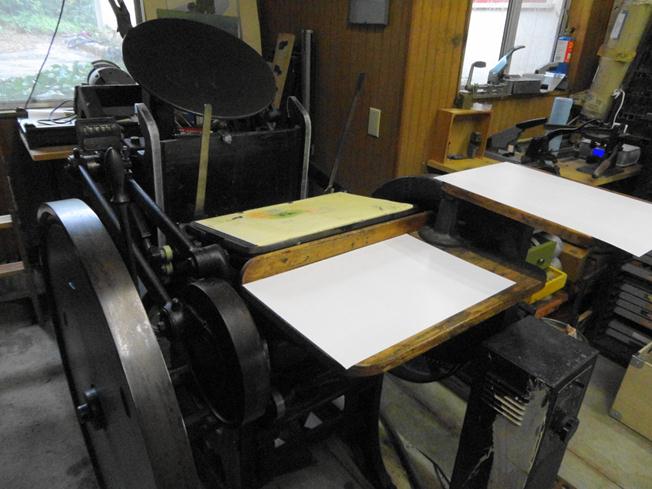
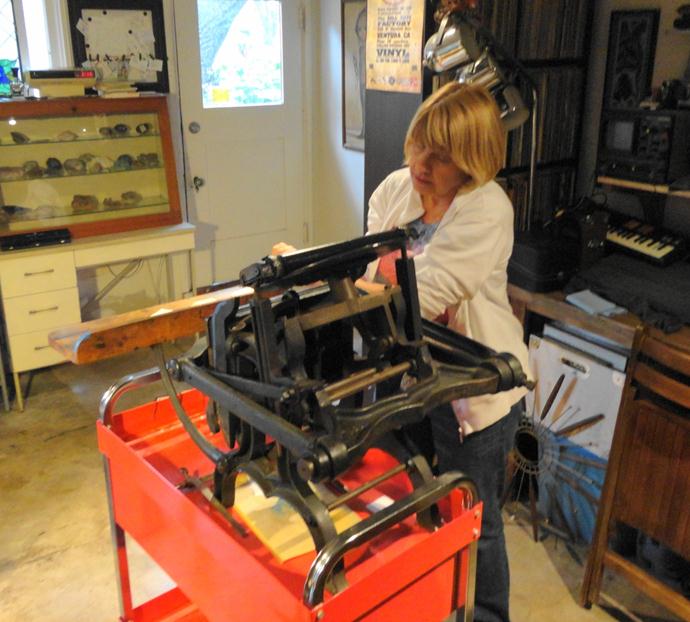
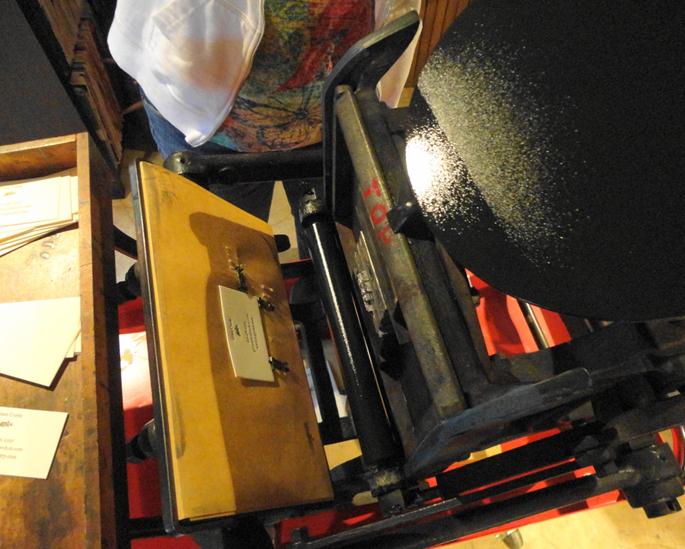
One of Lettre Sauvage’s large platen type presses.

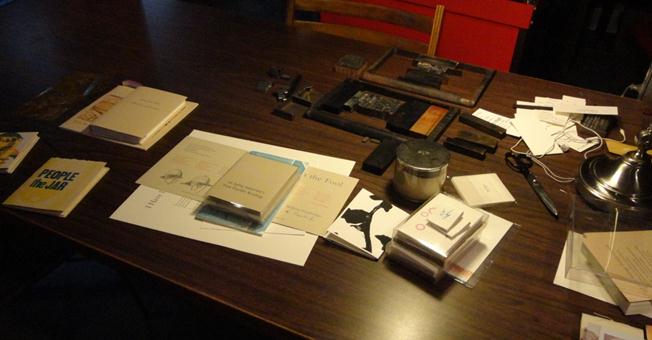
The work table is the heart of the studio—the place of layouts, design, binding, and packaging.

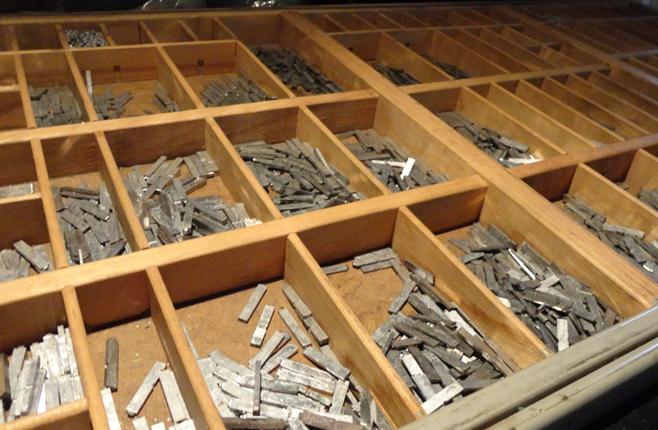
A type drawer with letters laid out such that can be easily picked up by practiced typesetters like Fiona.

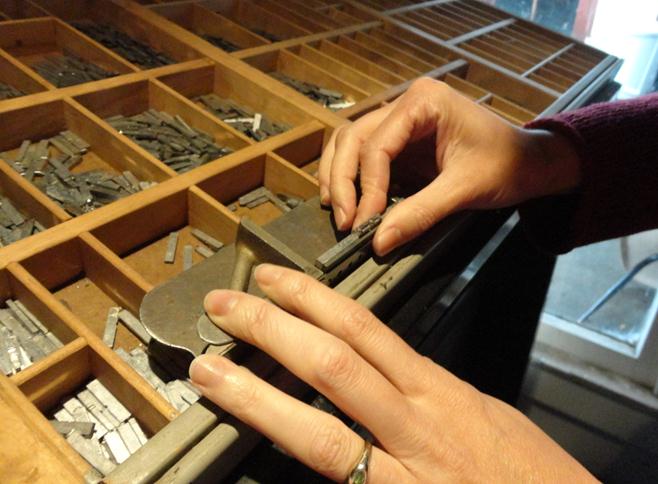
Individual rows of type are initially laid out on a composing stick. This is Fiona minding her p’s and q’s as she lays out my calling card.

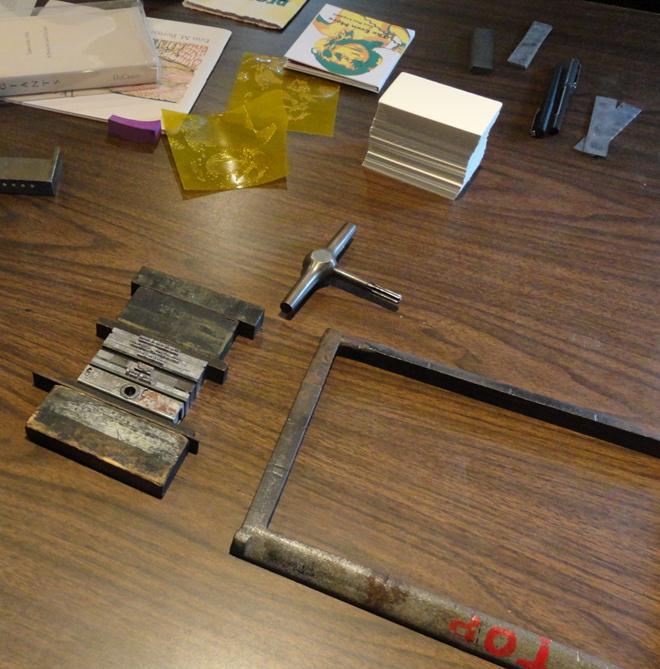
Rows of type and leading are fit tightly into a frame that will be attached to the press. The type is laid out as a mirror image of the final imprint. Polymer film is often used for larger projects. It provides a vastly expanded opportunity to use different typefaces and artistic elements. At the top of this photo, you can see some of the yellow polymer plates that were used by Lettre Sauvage on a book cover.

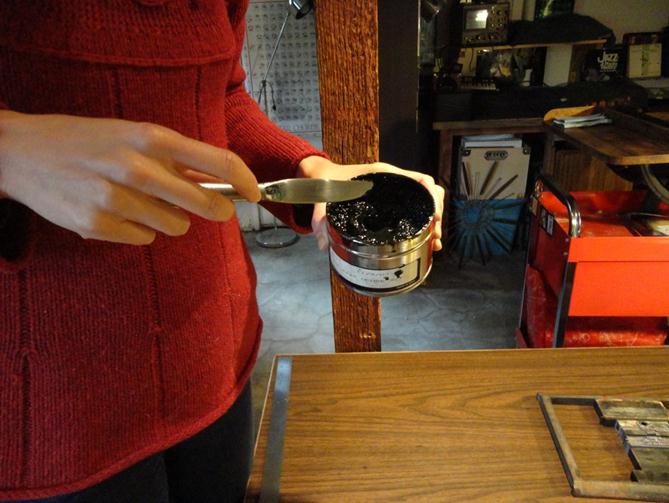
Dabs of ink are applied to a rotary platen on the small proof press used in my calling card project. On a platen type press, a roller rolls across the platen which evenly distributes the ink onto the roller. The roller then rolls over the type, coating it. Between each imprint, the platen rotates a quarter turn to ensure good distribution of the ink during the process.

The high quality, cotton based paper required in letterpress is cut to size prior to printing.

Fiona showed me how to feed each card into the press, and then how to apply just the right amount of pressure as I pulled the lever to cause the roller to roll over the platen, then across the letters, coating them, and bringing the paper to the inked type in one movement. On bigger presses some of this process is automated.

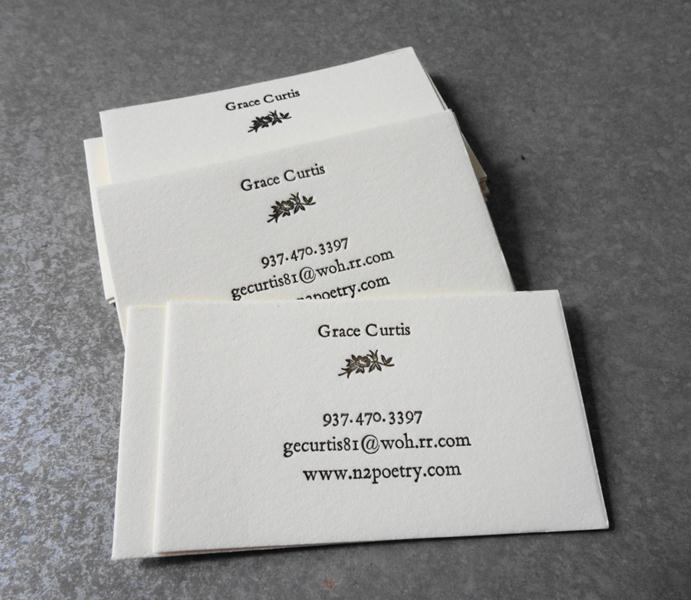
My calling cards in the making.

You can tell even from this photo just how lush the result is. It is wonderful to have such elegant calling cards, and even more rewarding to have a letterpress chapbook of my poetry.

© 2010-2012 Grace Curtis

Posted in Poetry | Tagged , , , , | 4 Comments

An Invented Poem Form

Radius, an online literary journal, says of itself:

Welcome to “Radius,” an online literary journal in blog format dedicated to poetry: How poetry works, how one poem or body of poems connects to another, how poetry exists in the world. We’re big believers around here that poetry doesn’t exist in a vacuum, and that it has a role to play in life, politics and culture.

Radius publishes, among other things, invented forms. They recently published my poem, “Extractions“, a play on the Paradelle, an absurd form invented by Billy Collins as a spoof on complex French forms. Here is an interesting example, “A Paradelle for Donald Rumsfeld“, written in 2007 by Ronald Wallace as a political comment. If you feel so inclined, create your own Paradelle or invent your own form and publish it in the comments. I’d love to hear from you.

© 2010-2012 Grace Curtis

Posted in Uncategorized | Tagged , , , , | 2 Comments

Santa Barbara Poetry Series, April 14, 2012

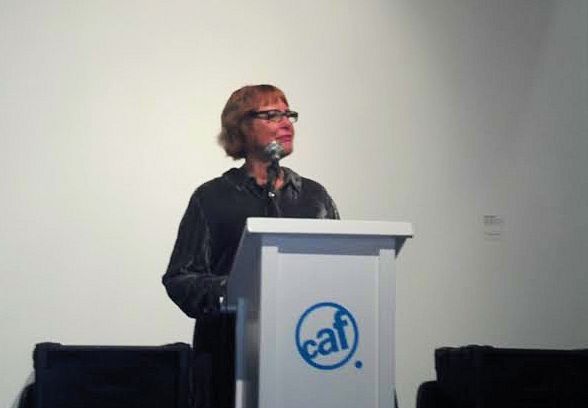
Each year, during April, Santa Barbara Poetry Series organizer, poet,  Carol DeCanio invites poets with a first book to read at a reading event that takes place in the captivating Contemporary Arts Forum in the Paseo Nuevo Mall, a downtown center for shopping and community activities in Santa Barbara.

I can’t think of a more beautiful place to have a poetry reading. Santa Barbara sits into the hills that just beyond it, seem to drop into the Pacific Ocean. The palms are a lovely contrast to the maple and ash trees of Ohio, and there is nothing comparable in Ohio to a morning walk along the shore of the Pacific, or to seeing mother grey whales with their calves making their way northward. I feel so fortunate to have been asked to come to this event to share some of my poems aloud, and so fortunate I was able to go. Besides being in such an idyllic setting, I got to meet many wonderful poets, and to spend time with Fiona Leggett, owner and publisher at Lettre Sauvage, a small letterpress publisher from Santa Paula. In a future post, I will be sharing more about that experience.

Carol DeCanio does such a great job with these events. She should be recognized for the work she does in the Santa Barbara area with this series. She promotes poetry in her community in a such a dynamic way. She is inspiring.

At this year’s April reading, which occurred on Saturday, the 14th, Carol  featured Fiona Leggett from Lettre Sauvage Press, and my book, The Surly Bonds of Earth, along with another Lettre Sauvage poet’s work, San Francisco-based poet, Brynn Saito. Saito’s first full-length book, Bright Power, Dark Peace, was selected as the 2011 Benjamin Saltman Award and will be published in late 2012. Judging from the work Brynn shared at the event, her book with be wonderful.

What a delightful event! I am so honored to have been asked to read with so many outstanding poets, including David Starkey, Gwendolyn Alley, Diana Raab, Suzanne FrostLouise Gerber, and BJ Riley.

More Pictures from the Santa Barbara Poetry Series, April 14, 2012 

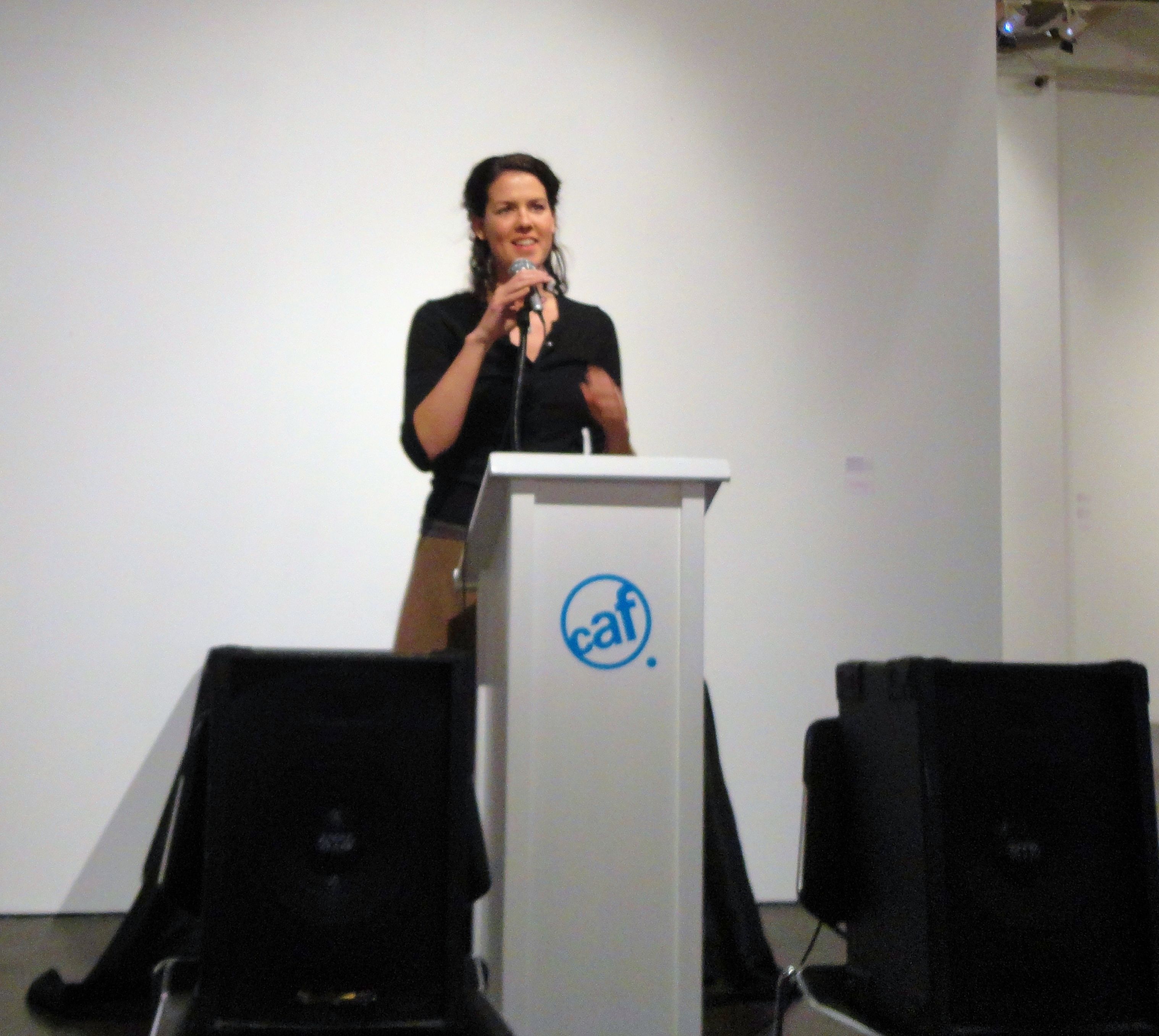
Carol DeCanio, poet and Santa Barbara Poetry Series Organizer

Fiona Leggett, from Lettre Sauvage

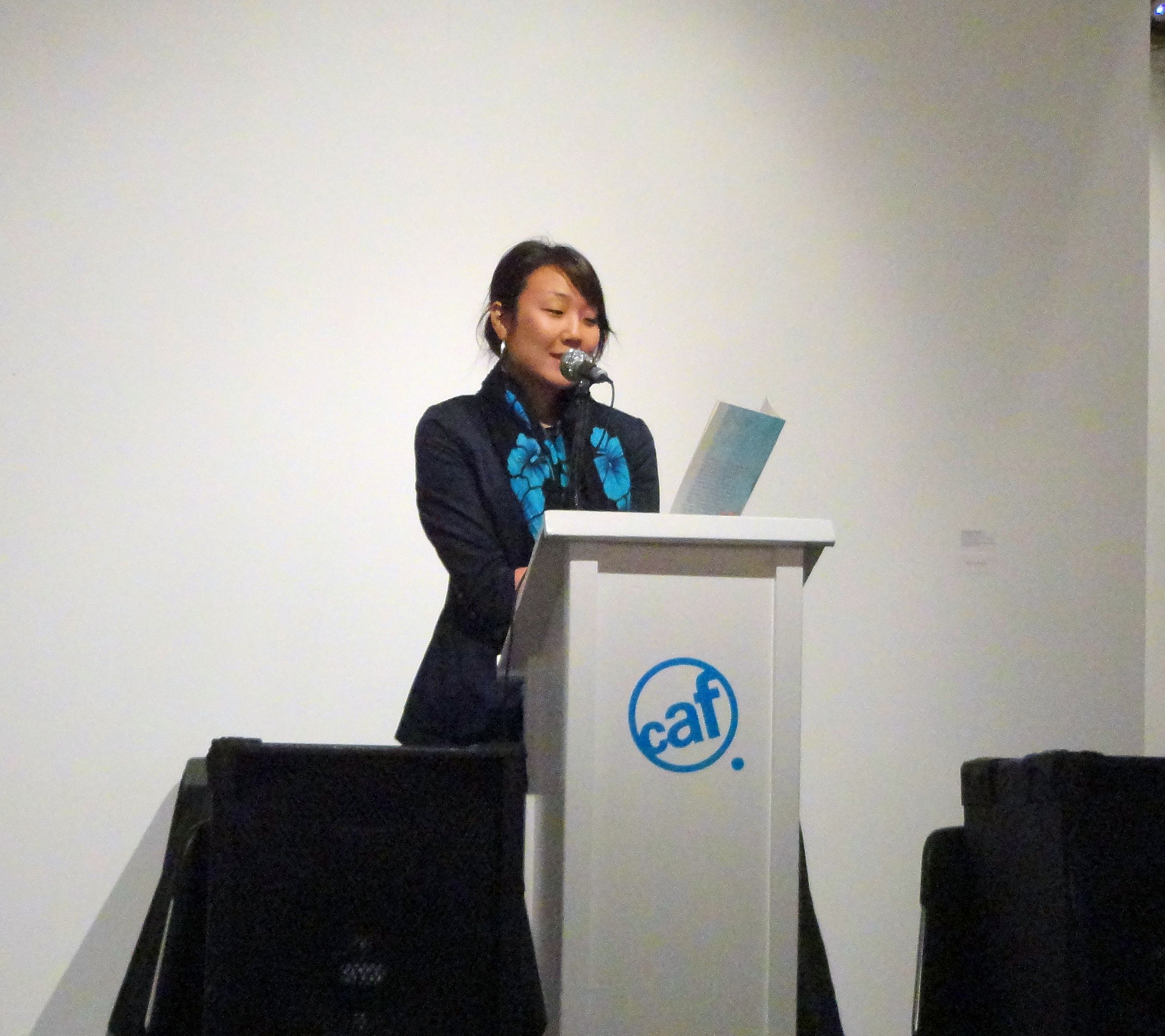
Poet, Brynn Siato reading at the Santa Barbara Poetry Series

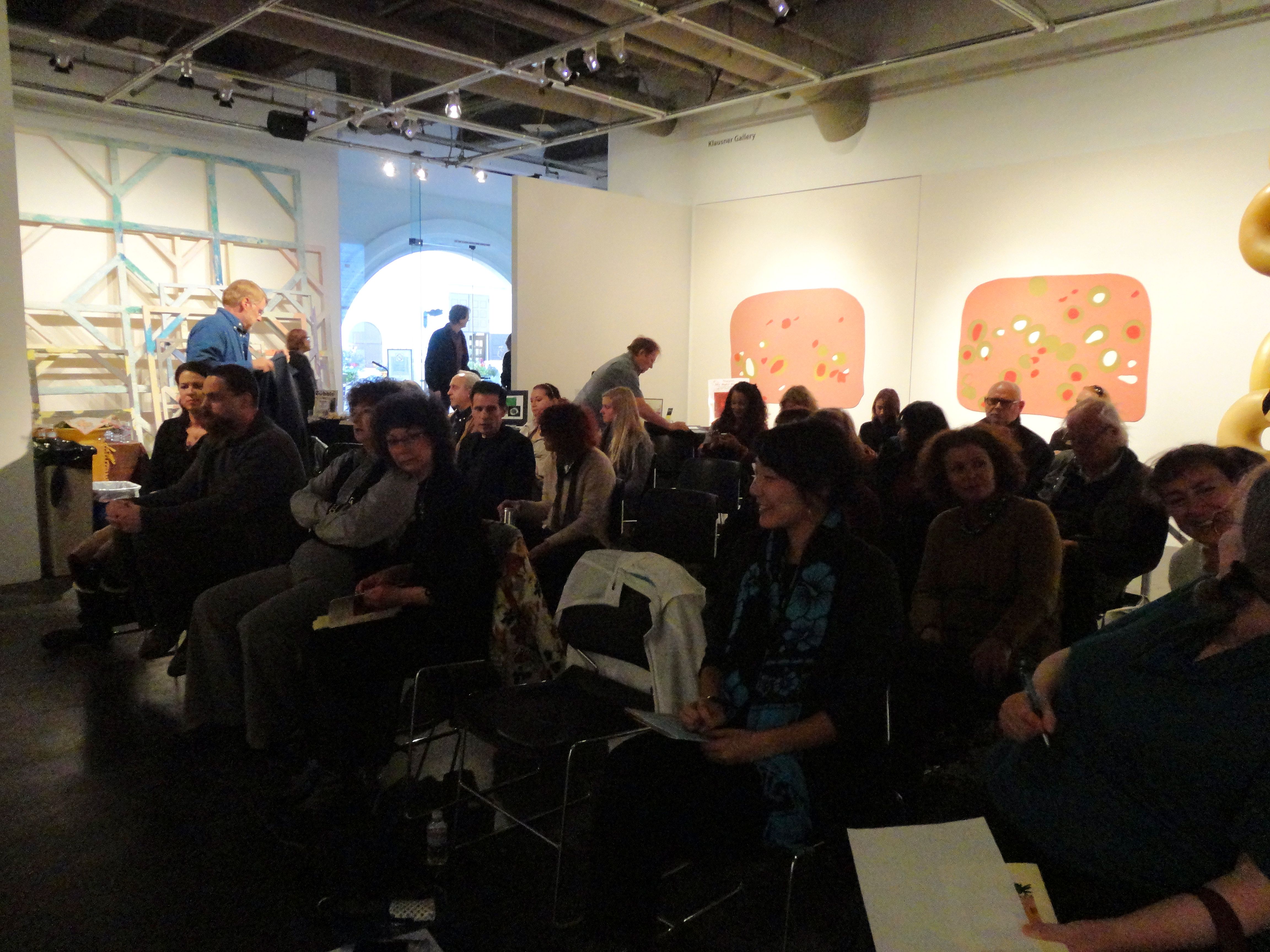
The amazingly supportive community of Santa Barbara gathered in the Contemporary Arts Forum in downtown Santa Barbara.

Poets were able to present their work to attendees. This was Lettre Sauvage’s table.

© 2010-2012 Grace Curtis

Posted in Poetry Events, Poetry Readings, Uncategorized | Tagged , , , , , | 1 Comment

Listening to Marcus Speh Read His Own Work

Since I recently posted about writer’s reading their own work, I am sharing a link to writer, Marcus Speh’s engaging website and podcasts. The short fiction pieces are enchanting and the readings are mesmerizing and beautiful. He also reads from the work of other writers. Notice how deliberately Speh reads. The timing and pace are wonderful.


© 2010-2012 Grace Curtis

Posted in Poetry Readings, Uncategorized | Tagged , , | 4 Comments

Tips on How to Read Poetry Aloud

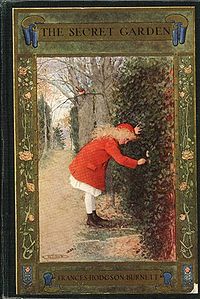
ImageFor several weeks during the fifth grade our teacher read aloud to us from The Secret Garden, by Frances Hodgson Burnett. She read right after lunch, so I would rush from home back to school after eating to get settled in before she started. I was reminded of that experience today after coming across a blog post from Oxford University Press on the topic of children’s literature.

Listening to our teacher read from The Secret Garden is one of the highlights of that year; in fact, it is the only thing I remember, besides getting under our desks for bomb drills—as if a desk would have provided even a modicum of protection if a nuclear bomb had actually fallen on us. I used to interlace my fingers across the top of the desk and lay my chin on them to listen to the story of Mary Lennox. Just thinking about it evokes sights, sounds and smells—chalk dust, Kenny Wilson’s perpetual sniffling, paper and books, the warmth of the afternoon sun as it came through the huge windows of the classroom. I was drawn into the story in such a profound way. Even now, I relish listening to books and poetry–especially poetry–being read aloud, if it’s being done well, that is.

The problem is that some poets are not good readers which results in poetry readings that are not always the kind of experience I want them to be. Some readers miss the opportunity to connect with the audience, and thereby miss the opportunity to promote their work properly, or to do it justice. They are also missing the opportunity to create a memorable experience for the listener.

A few years ago, I heard a very accomplished and famous poet, whose work I admire, read from her new book. By the time it was over, I was ready to go mad.  She consistently started each line with a high-pitched tone that descended through the line, and always ended with a sharp up-swing of the final word. She did this without fail, line after line. Had this person never listened to herself read? For me, it was nothing short of listening to a singer sing off key. Why hadn’t a friend or her agent—yes, a poet with an agent—coached her?

In a few weeks, I am going to do a poetry reading at the Santa Barbara Poetry Series so, lately, I have been thinking about my own reading skills. I want to make the experience rewarding for those who will attend; after all, they will be paying me the ultimate honor by listening to me read my poems.

I believe that with a little effort, it is possible to develop a good reading style. Listen to how beautifully, Li-Young Lee reads his poem, “This Room and Everything in it.”  Notice how slowly and intentionally Lee reads. The style is natural. It is a great model because it is hard to listen without getting every word—a worthy goal for a poet who has spent hours laboring over writing every word.

Here are some suggestions on how to be a better public reader. If you have others, I hope you will share them in the comment section.

  1. Slow down while keeping a good pace.
  2. Enunciate the words clearly.
  3. Speak loud enough to be heard.
  4. Avoid affected voices and styles.
  5. Avoid habitual reading patterns that are easy to fall into. It helps to record yourself reading and then to listen to it critically. By the way, this also even helps with editing. Often, the places where you stumble, need more work.
  6. Pause a bit between poems. Let the poem resonate for a minute or so before moving forward. This is something I became painfully aware of while watching myself on a video.
  7. Consider the order of the poems you are reading. You might start with a lighter, more accessible poem before diving into more complex work. Pick a good ending poem since the last thing you read might be the most remembered.
  8. Pick out the poems before you get to the podium. Nothing says, I didn’t give any thought to this performance or to my audience before I came here more than casually flipping through the book as if deciding what to read next.
  9. Give a very short introduction to each poem. This helps the audience transition between poems. I also think listeners like a little background. They can’t get that when they read the poems themselves so it’s a bonus.
  10. If the poem has an epigraph, my recommendation is to read the epigraph first, then the title. You can say something like, “This poem begins with an epigraph. . .”, then give the title right before you read the poem so listeners will connect the title with the poem.
  11. Try to look up as you read if possible. This is tricky because you can lose your place in the poem and that’s awkward. I keep my finger beside the line I am reading so, I can easily find my place should I happen to lose it. Also, if you have practiced enough, you tend not to lose your place.
  12. Most important of all—practice, practice, practice! Think of the reading as an artistic performance. Even if you are a better poet than performer, you can improve with practice. You owe it to those who give of their time to listen!

© 2010-2012 Grace Curtis

Posted in Poetry, Poetry Events, Poetry Readings, Uncategorized | Tagged , , , | 7 Comments

Tension in Poetry

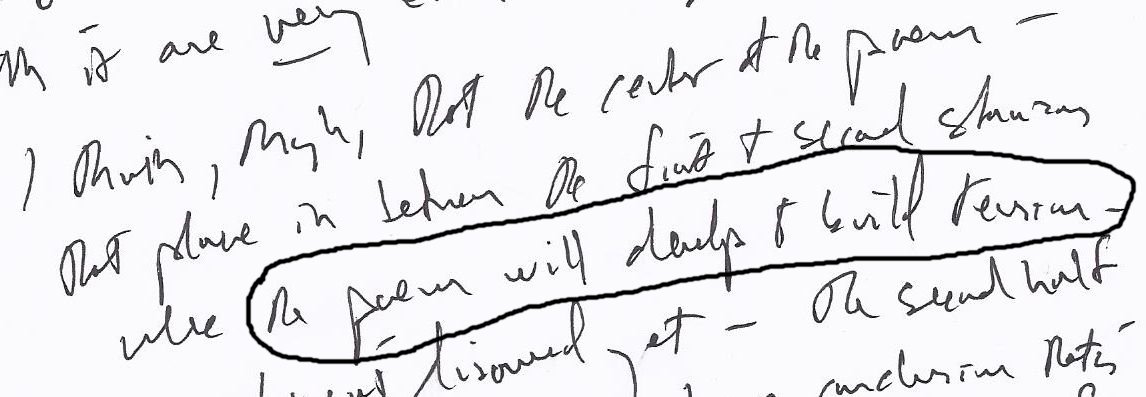
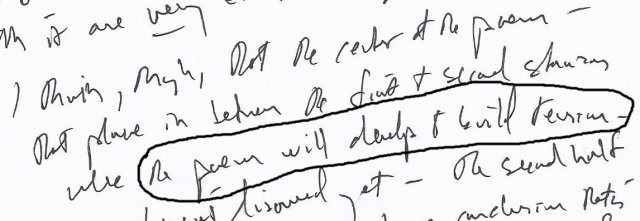
“…the poem will develop and build tension…”

Tension is a word my thesis advisor, Angie Estes, introduced me to the first semester I studied with her at Ashland University a few years ago. She would write things on my submissions like, “doing [this or that] might enable the poem to build tension.”  In fact, we spent a lot of time that semester talking about tension in poetry. What it is, how it works, and why it is so important.

So, what is tension, why is it important, and how does one achieve tension in a poem? I found  an interesting article, “Tension in Poetry”,  by poet,  John Orley Allan Tate [1899-1979] in which he suggests the word tension could be used to describe a way of looking at the poem as a whole to derive both its meaning and its effect.

“Many poems that we ordinarily think of as good poetry — and some, besides, that we neglect — have certain common features that will allow us to invent, for their sharper apprehension, the name of a single quality. I shall call that quality tension. In abstract language, a poetic work has distinct quality as the ultimate effect of the whole, and that whole is the “result” of a configuration of meaning which it is the duty of the critic to examine and evaluate.”

Tate, a leading member of the New Criticism school, specifically used the word tension as something he called a special metaphor that could be used by critics to evaluate poetry. He came up with it as a word  “derived from lopping the prefixes off the logical terms extension and intension.” I think he is suggesting a poem can possess a single critical aesthetic attribute—tension—that creates a more pleasing and more important experience for the reader.

Tate specifically derided some metaphysical verse of the 19th Century—although you could choose plenty of 20th and 21st Century poetry as well—as failing because it “yields a cluster of images that may be unified only if we forget the firm denotation of the terms.” Later he writes

“that good poetry is a unity of all the meaning from the furthest extremes of intension and extension. Yet, our recognition of the action of this unified meaning is the gift of experience, of culture, or, if you will, our humanism. Our powers of discrimination are not deductive powers, though they may be aided by them; they wait rather upon the cultivation of our total human powers, and they represent a special application of those powers to a single medium of experience—poetry.”

Earlier in the article, Tate suggests that poetry that fails in the “cultivation of our total human powers,” embodies the fallacy of communication in that it “communicates the affective state, which (in terms of language) results from the irresponsible denotation of words.”  Today when we think of tension, we are more apt to think of the tightness through the shoulders that results from being hunched over a computer keyboard all day or from bumper to bumper traffic on the freeway. It’s a word that has lots of meaning in our current culture.

According to Wikipedia, tension in physics is (the magnitude of) the pulling force (measured in newtons) exerted by a string, cable, chain, or similar solid object on another object. It doesn’t seem to me that this definition as a metaphor, is that much different than what Tate is getting at. Could tension in poetry be described as the overall force of the poem upon the reader that pushes against it? If you think of the poem as a string, cable, chain, or similar object upon which exertion is placed, the poem can be as tight as a violin string or as loose as a backyard trampoline, or, in some cases, even as a string just lying on the floor—which has no tension whatsoever.
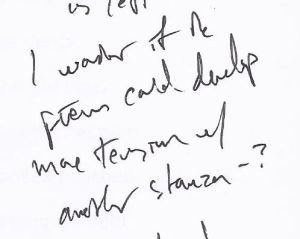
“I wonder if the poem could develop more tension with another stanza?”

You can almost feel the specific tension or lack of tension if you metaphorically press up against poems. The poem’s tension is the sum of all the poetic elements at play in the work: line breaks that create disjunction, or that reel it in, imagery, rhythm, subject matter, surprise, language—both the connotative and denotative meaning of the words along with their sound and visual effect—, restraint (or the intentional lack of it), rhyme, assonance, and others.

I think what Tate and his friends disliked was poetry that failed to achieve the kind of power–a stand-alone power–that a poem with the right amount of tension can create. He called this a fallacy in communication. I believe he specifically disliked things like gross generalizations, sloppy or inaccurate metaphors, lack of concrete—and accurate—imagery, weak, trite, or flowery language, and so on. As a critic he valued poetry that could stand on its own as art, without the need for any explanation or contextual frame of reference.

It is difficult to tell someone how to achieve an appropriate amount of tension in their work, although my mentor tried. Like Tate says, “Our powers of discrimination are not deductive powers, though they may be aided by them; they wait rather upon the cultivation of our total human powers…” I believe some poets—even very young poets (is this talent, perhaps?)—just seem to understand intuitively how tension can work in a poem, and, use it to extraordinary effect. Others, like me are lucky to have had someone to remind them of the value of looking at it specifically in their work, and of experimenting (adding an additional stanza, perhaps?) with how to create more tension and therefore, to create a more engaging experience for the reader.

To look at tension more specifically, I thought it might be fun to analyze the amount of tension and the tools used to create it in a segment of a poem by Angie Estes, the mentor who worked so hard to drive this point home to me. I like Angie’s work for it astounding language and startling reflections on love, life, music, art, and language. Her most recent book, Tryst, was runner up in 2010 for the Pulitzer Prize. This is a segment from a poem called “Cadenza” from her second book, Chez Nous.

“… What is the difference

between ripeness and letting time

have its way?  I would as lief

come now as later, as cadence

comes from cadenza, from Italian

cadre, to fall. Please

help me I’m falling

in love with you, the song

goes, a progression of chords moving

to a close like the fall

of Rome or love–. . .” (14-24)

To begin, Estes uses a good blend of both annotated and parsed lines, to use James Longenbach’s terms from his book, The Art of the Poetic Line, i.e. they are not annotated (or cutting across the syntax) so much that they could be thought of as “fussy” or “a way of jazzing up uninteresting syntax.”  Nor are the lines parsed, i.e. broken in more natural language places, so as to feel like the line is “merely repeating what the syntax is already doing on its own.”  (57)

Line breaks create tension, or control tension, by causing the reader to take pause, and if only for a second and if only on a subconscious level, to reflect on the meaning of the line and the words in the line. For instance, If you took the first sentence as an unbroken line,  “… What is the difference between ripeness and letting time have its way?”,  it is less strenuous to apprehend, than breaking it after the words  difference and time as Estes has done. The breaks are pushing against the reader in a subtle, but significant way. Breaking the lines causes the reader to ask, what “difference”?, or “letting time” do what?”

Line breaks are not the only element creating tension in Estes’ poem. She frequently incorporates foreign words, most often French, in her poems. In this case she uses Italian, “from Italian/cadre, to fall.”  Not knowing the exact translation of the word or short phrase in her poems never feels like a problem to me because it is almost always clear what the word means in the context of the poem; or, she often reveals it with playful exploration of the word across languages. Using foreign words effectively in this way, causes the reader to take pause. I find the effect intriguing. It demands a heightened awareness that is both exciting and intellectually stimulating.

Further, there is a progression in the exploration of the word cadenza even in this short passage that pulls the reader along. Cadenza is a musical term and Estes plays off of it, both denotatively, i.e. as an actual artistic interlude as she plays with the word and its origin as a kind of credenza in poetry, in and of itself, and on a connotative level, as she plays with a progression of the words around cadenza, like a “chord” progression which she references in the third line from the bottom.

However, the most surprising element in the poem—another way Estes creates tension—is the juxtaposition of a reference to the popular 1960s love long written by Don Robertson and  Hank Lockin, I Can’t Help Falling in Love With You.  She butts a term from classical music, cadenza, up against the reference to a popular love song; and further, she plays off the word “fall” in combining the broadly disparate, and therefore, tension producing, images of “the fall of Rome” with falling in “love.”

There are more subtle tension-creating elements in this poem: the play on the “C” words, the “morphing” of the words to their origins or to derivatives. The shorter line lengths set the speed and resist a slow, drawn out reading. There is a tie back to the musical foundation of the piece in that even its rhythm connects musically. There is also a subtle looping back to the fact that a chord progression almost always resolves at the end of a pop song, just as cadenza often occurs near the end of the movement as described by The Harvard Dictionary of Music.

“Although a cadenza may occur elsewhere, it most typically ornaments a prominent tonic cadence, such as one before a final *ritornello or *coda.”  . . . “over the penultimate or antepenultimate note or harmony of a prominent cadence.” (132)

I know I have risked ‘over-analysis’ here, but I think this passage beautifully illustrates how the right amount of tension works in a poem using a variety of elements. Line breaks, restrained and extremely intentional language, surprising and juxtaposing imagery, sound, and rhythm create for me, as a reader, ‘good’ tension, the kind of tension I want in the poetry I read, and the kind of tension I strive for in my own work.

 Works Cited

Estes, Angie. Chez nous. Oberlin, OH: Oberlin College Press, 2005. Print.

Longenbach, James. The art of the poetic line. Saint Paul, Minn.: Graywolf, 2008. Print.

Randel, Don Michael. The Harvard dictionary of music. 4th ed. Cambridge, Mass.: Belknap Press of Harvard University Press, 2003. Print.

Tate, James Orley Allen, Tension in Poetry, http://www.google.com/url?sa=t&rct=j&q=&esrc=s&frm=1&source=web&cd=1&ved=0CCoQFjAA&url=http%3A%2F%2Fecmd.nju.edu.cn%2FUploadFile%2F17%2F8083%2Ftension.doc&ei=qOdwT_XsGMTa0QGA1tXvBg&usg=AFQjCNF3mSJLNEHsgrXPRlotSugis29Iag . Online.

© 2010-2012 Grace Curtis
Posted in Craft in Poetry, Poetry, Poets I Really Like, Uncategorized | Tagged , , , , , | 11 Comments

Osage Orange Tunnel

Osage Orange Tunnel

You can stand at its entrance and see
hundreds of bows, the bow trees arching,
holding cows at bay, the hedge
mainstay of first farmers. So complete
the interlock, the large fruit,
heavier brother—more orange
textured than apple. More green-
apple colored than orange. Orange
rooted and firm, more branch-bowed
than straight, more arch-like,
like two lines of soldiers
rifle-crossed for a bride-walk
or for early morning
hiker awestruck.

from a photo prompt 3/11/2012 compliments of  The Mag

© 2010-2012 Grace Curtis


Posted in Poetry, Uncategorized | Tagged , , | 22 Comments

The Poetry of Maintenance Manuals

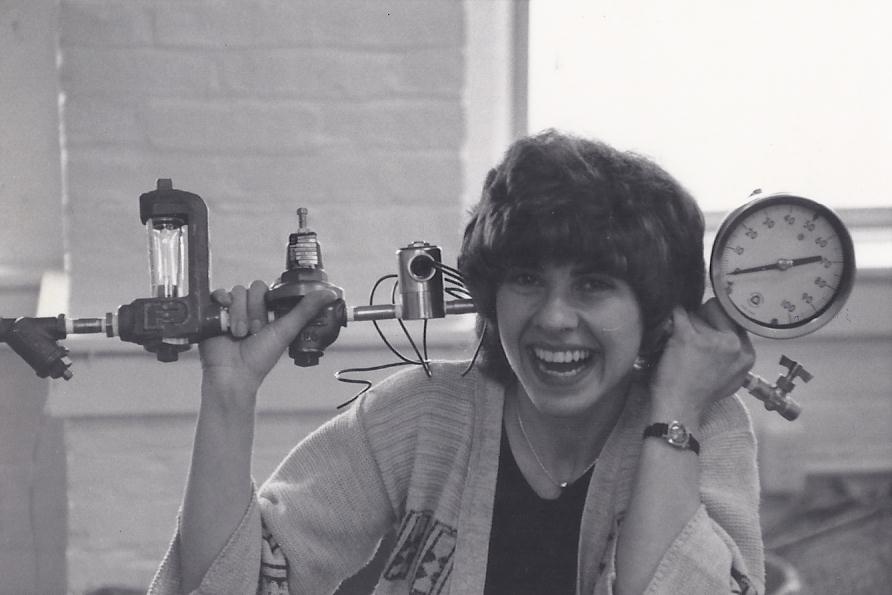
Years ago, I started my writing-for-pay career as a technical copywriter, delving into something I knew nothing about—an industrial line of pumps for the waste treatment, oil and gas, and food industries. It might not sound very glamorous, but to a twenty-something it was a pretty good gig. During the job interview, which included a tour of the manufacturing plant, I commented on the way the pump functioned, innocently using the word sheer, not knowing at the time that the word shear is technically applicable in the spec’ing of this product for an application. As it turned out, it was a job-clinching fluke. Within days, I was in the lab working with engineers to disassemble and reassemble the product, step by step, taking notes and learning a new vocabulary. I was also leaning to do what I now do as a poet—to say the most in the fewest words, like these, for example, from one of the manuals:

When replacing packing, insert two rings on the shaft, the lantern ring, and then, four more rings. This will allow the lantern ring to line up with the grease fitting.

Today, some of the very manuals I worked on, and their close relatives, are still in use and can be found on the company’s website not because the writing is so good that it has withstood the test of time, but rather, because the product is so solid and elegant in its design and function that it is still being manufactured and used in same way it was back then—to move viscous or lumpy material from point A to point B—material like sewage, oil sludge, and cherry pie filling. There is little need for new manuals.

My stint as a copywriter with an industrial goods manufacturer provided me two critical take-aways. First, it taught me that you can pack meaning into a few words by using just the right words, strategically placed. On the website for The Antioch Review, Robert Fogarty, editor, has written that the journal has a continuing commitment to publish the best words in the best order, which, by the way, is precisely the goal of a good maintenance manual. I often think of Fogarty’s words as I write poetry.

Second, I leaned through this job, how much I love language. Even today, I find myself thinking about the fact that ketchup is a  thixotropic fluid, meaning that it starts out moving slowly. Shear force, generated by the initial movement, then causes it to begin to flow more quickly creating a unique pumping problem. Further, I found the word borrowing used in this industry, fascinating. Words like lantern ring, stuffing box, shaft collar, and packing gland—terms that were used every day by the company’s sales and engineering staffs—still dance around in this logophile’s ears some thirty years later, and even work themselves into the occasional poem.

While maintenance manuals are not literary documents by any stretch, the connection is an interesting one in that they both share the attributes of language beauty and economy. There is a critical element of “crafting” that goes into writing good poetry just as a kind of crafting goes into writing down instructions for someone else to follow. (We’ve all experienced manuals in which good crafting was clearly not a consideration.) Besides paying the bills, writing manuals proved to be a useful writing exercise.

Craft in poetry can be its most elusive aspect. It can be difficult to teach, difficult to explain, and even more difficult to get right. Yet, I suggest good crafting separates poetry we like from poetry that does not appeal quite as much. After an initial reading of a particularly pleasing poem, my first thought is:  How did the poet do that?  Good poetry craft is manifested as clearly evident—or rather, subtly evident—intentionality with regard to word choice, structure, rhythm, disjunction, coding, line breaks, title, visual appearance, etc.

In previous posts I have written about poets who write with the kind of attention to craft that appeals to me, and that I use as models—Larry Levis, John Siddique, Diane Wakoski, Martha Modena Vertreace-Doody, James Dickey, Jamey Dunham, and others. I once heard C.K. Williams say that he picks a specific poet and reads everything they have written, spending time with their work. This is his way of going to the lab and taking the pump apart. How else can you figure out how the thing works.

© 2010-2012 Grace Curtis
Posted in Craft in Poetry, Poetry, Poets I Really Like, Uncategorized | Tagged , , , , , , , | 4 Comments