In Remembrance

August, 2001

© 2010-2012 Grace Curtis

Posted in Poetry | Tagged , | Leave a comment

Avoiding Publishing Negativity by Joey Connelly, Guest Blogger

We try and try, don’t we?  Being a poet requires the sacrifice of several virgins, and we, despite advanced educations and countless hours questioning the validity of each comma, keep at it, submitting to any journal that has even a passing waft of legitimacy, and we do so while mitigating our negativity.  No one likes a bitter poet, no matter how anthologized.  So we keep track of our rejections, pretending to be entertained by the sheer silliness of it all, planning where we will send our piece next to be judged by cavalier strangers.

Publishing remains a cult of personality.  Big names are published everywhere, as if success ensures future success, as if prolific work yields only many masterpieces.  You know these guys (I am using all the restraint I have to not name names) are phoning in work at this point, and I will gladly offer evidence if you send me a personal message.  And it makes sense, doesn’t it?  Poetry isn’t hugely marketable to non-poets, so a big, Pulitzer Prize winning and easily recognizable name helps viewership.  We understand this.  We also understand how difficult that makes things for us who have not had substantial publishing.

So what can we do to avoid being bitter?  The whole process is defeating and demoralizing, and we constantly have the conversation with ourselves about art versus commerce, how being ignored in his/her lifetime is one of the hallmarks of every great writer (even though we know this isn’t exactly true).  We take comfort where we can find it.  For example, I never related to Sylvia Plath more than when I too didn’t win the Yale Younger Prize.  These ephemeral moments of comfort are what make the process bearable.  The occasional acceptance letters are what make the entire enterprise worth it.

But the hardest, most ridiculous, most infuriating rejection comes from contests.  We enter for the same reason we play the lottery.  Someone has to win.  But each year, one poet judges all of them.  This year, the great Carl Philips judged the Bakeless Prize, Yale Younger, Griffin Prize, and countless others.  He was listed as the judge for almost every major book prize available, and although I entered every contest, my manuscript never reached his incredibly talented hands.  Why is this, especially considering I paid a reading fee for each and every one in this very difficult economy when I live on a new professor’s salary and am swimming in student loan debt?  Two words: student screeners.  These students, who have yet to leave the side of famous mentors, whose work is still a rehash of other poets whose work they emulate until their individual voices come through, hold our prepaid fate.  At this point, if I win a contest where the prize is the typical $1000, I will still have paid more to enter prizes than I will have earned.  Crazy, no?  What a thing to do, what a dream to follow!

Still, though, the greatest tool I have to fight bitterness at the whole process of publishing is the whole process of writing.  I can never be too frustrated at the lack of publishing as long as I am still producing or editing my work.  The work, as cliché as it sounds, sustains me.  I will never ever be anything but grateful for the life I am fortunate enough to lead.  I have a full time academic job, and I am fully aware of the dearth of these jobs and the competition for these jobs.  I wake up every morning and thank the academia gods who bestowed such a career on the likes of one like me.  I used to work for government; I know how much better this job is, with all the frustrations that may accompany teaching.  And despite my passing frustration with the publishing industry, I will continue writing and submitting as long as the possibility exists that my work will be read and appreciated like all the poetry I have read and appreciated in my life.

I like to picture a very pissed off Elizabeth Bishop, checking her Vassar mailbox, opening a rejection from Poetry Magazine, and swearing.  We all should know that rejection from the establishment is a major part of our literary heritage.  And besides, remember this when your bitterness becomes insurmountable and threatens to darken your spirit: if we were universally accepted and popular with all, we wouldn’t be artists.  We would be greeting card composers.

Bio: Poet, Joey Connelly earned his MFA from Ashland University in 2010 and is Assistant Professor of English at Kentucky Wesleyan College.  His work has appeared or is forthcoming in The Rumpus, Peripheral Surveys, Medulla Review, Louisville Review, and others.  

My thanks to Joey for this post!  We both look forward to hearing from you.

© 2010-2012 Grace Curtis

Posted in Poetry, Rejections, Uncategorized | Tagged , , , , , | Leave a comment

My Top Ten Favorite Poetry Podcasts

These podcasts are why I go for long walks every evening.  All are free and available on iTunes.  You can listen to them through iTunes on your computer so you don’t have to own an iPod; although, why wouldn’t you? 

1. Poetry Magazine Podcast – Poetry Foundation Christian Wiman and Don Share talk for approximately 20-30 minutes about what’s featured in the current edition of Poetry Magazine. They read some of the poems, or have the poets read them, and they talk about some of the essays. When I first discovered these, I was years behind—they go back at least to 2007—so I listened to a new edition everyday for weeks! I would know Christian Wiman and Don Share’s voices anywhere.

2. Poetry Off the Shelf – also from Poetry Foundation, presented by producer Curtis Fox. These are generally shorter poetry discussions. In fact, Poetry Foundation had many wonderful podcasts and audio presentations on a variety of poetry topics.

3. UCTV Lunch Poems – presenting notable poets, such as Eavan Boland, Lisa Chen, Nathasha Trethewey, and Li-Young Lee to mention only a fraction of the poets who read in this series.

4. 92nd Street Y Podcasts – some are poetry, others are fiction or non-fiction writers, or journalists. All are wonderful!

5. PennSound Poetry Podcasts – today’s most well-known poets read and discuss their work.

6. Scottish Poetry Library – interviews, poems, snippets of events and music from the Scottish Poetry Library. These podcasts are delightful and provide a taste of mostly current Scottish poetry and music although there are sometimes poets and musicians from around the British Isles. As a word of forewarning, you have to listen carefully because everyone talks at warp speed on this podcast, including its entertaining host, poet, Ryan Van Winkle.

7. Slate Poetry Podcast – this podcast features the audio poetry presented in Slate. My only complaint about this series is that they do not give the poet’s name or the name of the poem during the podcast. You have to remember to look at the listing on the iPod and all that shows is the title of the poem and not the poet. You really have to dig to learn the poet’s name and to connect them with their poem. More than once I have found that frustrating and I think it is a disservice to the poets. I think it would be nice to have the poets say their name and the name of the poem. I still like to listen to this podcast because, of course, the poems are wonderful.

8. Wallace Stevens – Selected Early Poems (i.e. prior to 1923) – read by Alan Davis Drake (Cloud Mountain). Drake reads the poems one by one, giving the titles. What can I say? Amazing and soothing after a hard day at work.

9. Houghton Mifflin Poetry Podcast – The quality of this podcast is exceptional and the poets are notable. They read and talk about their work, and the writing process.

10. WNYC’s Radiolab – Not a poetry podcast at all, but still one of my all-time favorites so I had to include it. It’s hard to describe Radiolab so I thought I would share what they themselves say about it: “Radiolab believes your ears are a portal to another world. Where sound illuminates ideas, and the boundaries blur between science, philosophy, and human experience. Big questions are investigated, tinkered with, and encouraged to grow. Bring your curiosity, and we’ll feed it with possibility.” All true and then some! Jad Abumrad and Robert Krulwich, the show’s hosts are two voices I also know very well!

There are many others I listen to on my daily walks, but these are my favorites. And, I am sure there are many others I don’t know about, so, please share your favorites in the comments. I am always looking for new ones.

© 2010-2012 Grace Curtis

Posted in Poetry, Poetry Podcasts | Tagged , , , , , , , , , , , , , , , , , , , , , , , , | 1 Comment

Getting It Together Over a Number of Occasions

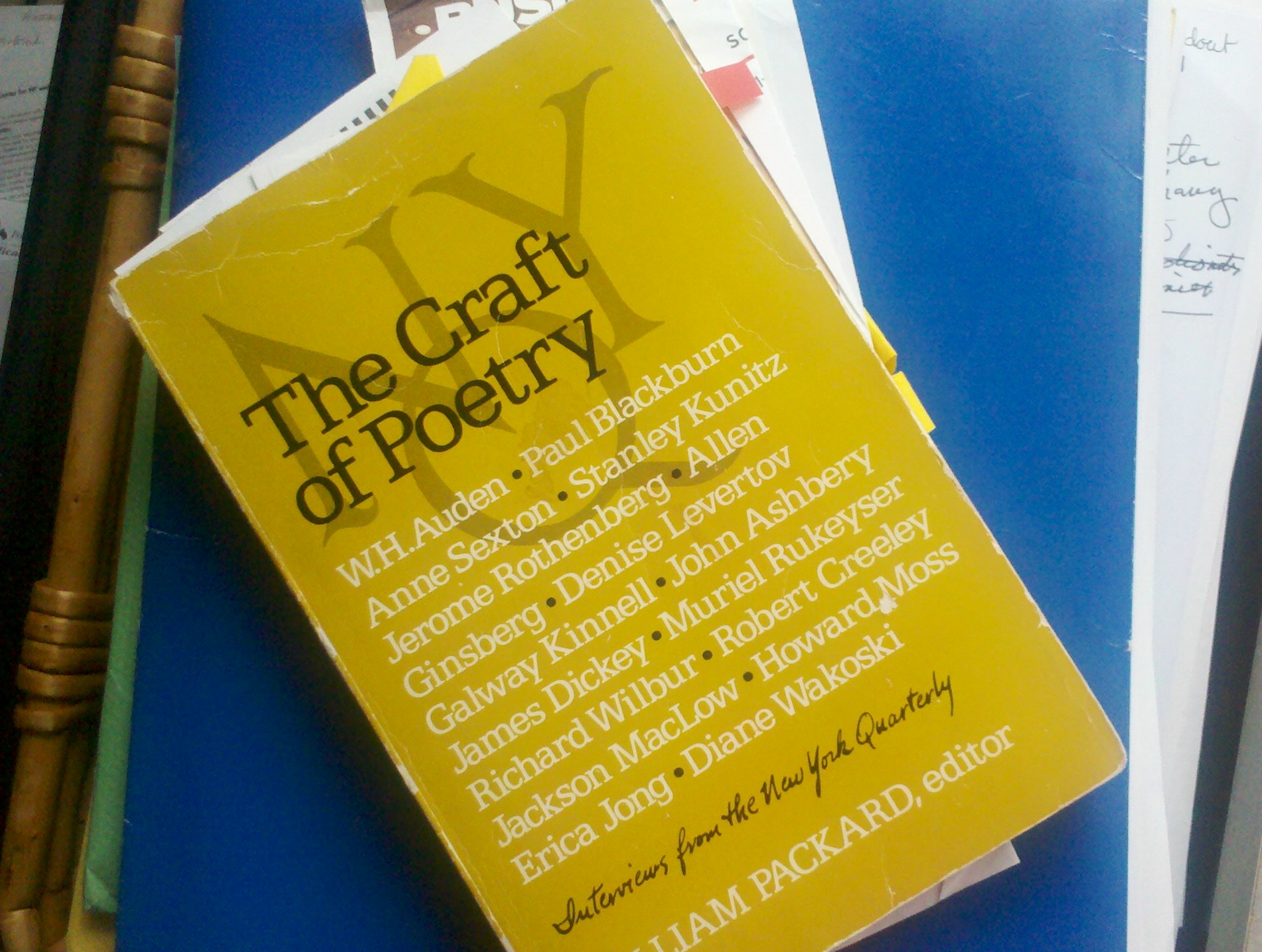
One of the standard questions asked of the many poets in the interviews republished from the New York Quarterly, in the book I featured in my last blog, The Craft of Poetry, Interviews from the New York Quarterly edited by William Packard, (now out-of-print), was about their revision process. For example, here is the exchange when the question was put to Jerome Rothenberg:

NYQ:  What do you feel about revision in your own work?

JR:     This whole question of revision seems to me to be a matter of overcoming distractions. When I’m not distracted to begin with, when I’m sort of concentrating, experiencing a peak of concentration, then I basically don’t have to revise what I write. I do tend to be distracted. In other words my discipline in terms of being able to focus on the work is not so great that I invariably write without revision. So revision is an attempt to return, to make up for that loss of focus. In some sense being distracted by sounds, people on the telephone, all of those things take me off into different directions, and I haven’t tended to write poetry in which I can take advantage of wandering off. I am trying to focus. The poetry may have its own gaps, but it’s a form of concentration. If I can’t get it all together at one time, then I have to get it together over a number of occasions. And sometimes something that starts well enough doesn’t come to any conclusion.

Allan Ginsberg indicated something similar in his interview stating that, “[He does] as little revision as possible. The craft, the art consists of paying attention to the actual movie of the mind. Writing it down is a by-product of that.”  He also goes on to talk at length about the focus and concentration Rothenberg mentions.

My work tends to require lots of revision and these two processes–writing and revising–are very different activities for me.  The initial writing is often a more delightful, inspired event. Revision, even though it demands a great deal of creativity, feels like a different kind of mental activity, more critical and well, more like, work. To me, it feels like where the real poem is often created.

I actually like revision and that’s a good thing because revising my manuscript is all I have been doing for the past several weeks. . . also the reason why I have been remiss in posting more frequently. For many reasons, I hadn’t gone back to the manuscript as a manuscript in several months. By letting the poems set for a while, I find that I am seeing them with entirely new eyes. It is a different  journey than the one I went through putting them together in the first place. I don’t know how this works for others but for me, since this is my first full-length manuscript, it’s been nothing short of a revelation .

Some poems I liked originally, I have taken out, altogether (even Rothenberg acknowledges that some poems that start out well, don’t come to any conclusion); while, others I thought about taking out earlier, I kept in and they have become—through revision—some of the strongest work in the manuscript. Also, I find that I am more willing to experiment with form, language, and lineation perhaps because, I can be more objective at this point perhaps because I am not as emotionally tied to the initial inspired creation. Further, I am reading and being influenced by different poets at this point and that is very clearly influencing the revisions. Finally, when I gathered together some new poems I had written over the past several months, and added them to the manuscript, I realized the book simply wasn’t done before. It still isn’t, but it feels like it’s getting closer.

As a more mature (in years, anyway) young poet, I am often tempted to feel like I don’t have enough time in my life to let my poems sit for several weeks or months before I come back to them. But coming back to the manuscript after a hiatus has shown me that there really is something very useful—at least for me—in putting a poem down for a while, then coming back to it. There is real value in letting the poem exist outside of my bias or perception undistorted by my emotional investment in it.  It creates important creative objectivity.

© 2010-2012 Grace Curtis

Posted in Poetry, Revising Poetry, Uncategorized | Tagged , , , , , | Leave a comment

Finding the Poetic Needle in the Haystack at the NFSPS Conference

Chicago poet, Martha Modena Vertreace-Doody was one of my luckiest finds at the National Federation of States Poetry Societies’ 2011 Annual Conference in Dearborn, Michigan over the weekend of June 16-20. I went there hoping to connect with living, breathing poets. Everyday I participate in a rich Facebook and Twitter writer community and while fun and informative in its own way, it’s not enough, or even real for that matter, and I am still very much engaged (more like consumed at the moment) in work that involves computers and software. . . not a lot of time to work on building a strong local writing community though I am trying to with the help of a few other local poets and especially with my friend, Julie Moore.

Frankly, I miss being in the MFA program (2008-2010) at Ashland University where I was surrounded by amazing poets and writers. You end up being spoiled by that kind of literary fellowship. Beyond having to crawl out of the black hole of post-MFA trauma (a normal response, I’m told), I truly miss the inspiring exposure to my fellow students and to poets like Angie Estes, Peter Campion, Steve Haven, Katherine Winograd and so many others I was fortunate enough to come into contact with during my tenure at Ashland.

That made finding Vertreace-Doody all the more delightful. First of all you can tell immediately that she is a kind and non-assuming person, so approachable. Also, she has a thoughtful, reading style that makes her easy to listen to—not too fast or slow, no unusual inflections, or droning up-takes on the end lines. You can hear her read her poem, Under The Full Crust Moon, here.  She appears to possess broad experience in cultures and locales around the world that just makes her an interesting person, and most importantly, she writes beautiful poetry. For example, from her book, Glacier Fire, (Word Press, 2004), her poem, Reading in Bed begins:

Your letter ends as night
                    settles in waves
among stands of cattail
          blurring the track.
Nothing to declare at the border,
                    except monarchs spent in mating,
dancing to Earth, wings carpeting
          the rainforest canopy.
Once at home, I know what to say
                    when all that’s left of summer
paints a fringe of hollyhocks along the highway,
          blue and white pinwheel
tents of yesterday’s carnival.

For me, Vertreace-Doody’s poems possess what James Dickey coined, “presentational immediacy.” This is a term he picked up from his study of the work of philosopher, Alfred North Whitehead. In an interview with the New York Quarterly (Spring, 1972, No. 10, available in reprint), Dickey discusses  presentational immediacy.

“NYQ:  If we can shift a bit.  You use a phrase, a concept you call “presentational immediacy”—

 JD:      That’s a phrase of Whitehead’s.

NYQ:  Well, you describe it as a “compulsiveness in the presentation of the matter of the poem that would cause the reader to forget literary judgments entirely and simply experience.”  Does this have to do with the oral presentation of the poem?
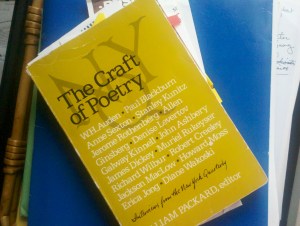
My Favorite Old Go-To Book

JD:      No, no.  I don’t mean it in that sense. In fact, I’m using it in a different sense from Whitehead. No, I mean, for words to come together into some kind of magical conjunction that will make the reader enter into a real experience of his own—not the poet’s. I don’t really believe what literary critic have believed from the beginning of time:  That poetry is an attempt of the poet to create or re-create his own experience and to pass it on. I don’t believe in that. I believe it’s an awakening of the sensibilities of someone else, the stranger. . .” (from The Craft of Poetry:  Interviews from the New York Quarterly, William Packard, editor, 1974, pp 140-141.)”

Vertreace-Doody’s poetry achieves this presentational immediacy described by Dickey, drawing me into it, into a real experience of my own through the reading of it. I particularly like the line that begins:  “Once at home, I know what to say/when all that’s left of summer/paints a fringe of hollyhocks along the highway.”  From time to time, I find myself gasping slightly, (could this be an awakening of my sensibilities) as I often do when I read poetry that speaks to me in this way. I believe that happens when there is present, the “compulsiveness in the presentation of the matter of the poem that would cause the reader to forget literary judgments entirely and simply experience.”  Poems throughout Vertreace-Doody’s book, Glacier Fire do this over and over.

What Vertreace-Doody spoke of and read to us from at the NFSPS Convention is her current project which is a series of historical poems surrounding the life of Elizabeth Caldwell Duncan (1824-1876), the wife of Illinois’ first congressman, and later its governor, General Joseph Duncan. Ironically, Vertreace-Doody talks of being inspired to pursue the series after reading Recovering Ruth, a Biographer’s Tale, written by Robert Root, a creative non-fiction writer who also just happens to be a faculty member in AshlandUniversity’s MFA program.  Vertreace-Doody said she was inspired by Root’s beautiful prose writing in addition to his attention to the historical detail. She read several poems from her new work (which I will promptly acquire although there are no specific dates or publishers as of yet. Vertreace-Doody does not seem to be in any hurry to leave this project, or perhaps more accurately to leave Duncan.).  In a craft session, Vertreace-Doody walked us through the details of her exhaustive research over several years. She says she can actually feel Duncan’s presence at times having become so familiar with the most intimate information about her life although she is quick to add that she doesn’t even believe in such things.

I am so grateful for having gotten to meet Martha Modena Vertreace-Doody and to hear her read and to have heard her share so passionately about this new work. It was inspiring and just what I needed to feed my hungry poet soul.

© 2010-2012 Grace Curtis
Posted in Uncategorized | Tagged , , , , , , , , , | Leave a comment

The Dawn of a New Blog

I started this site because, well first of all, I have always wanted to blog about poetry. (Who doesn’t want to blog about something, right?) But, until a couple of weeks ago when I quit my demanding fulltime job of the past 27 years, I never felt I had the time to do blogging justice. So, now I have time. . . .sort of.  I am still working as a resource for my former employer about 20 hours a week, at least for a while. It’s a good transition for both them and me and, mostly for my husband who is entirely freaked out that I quit my job.

Second, I have a new chapbook, The Surly Bonds of Earth, that was released on June 3rd and this seems like one way to promote it.  Also, this is one way to get to talk about poetry (and the occasional other nonrelated topic), which is something I love to do and haven’t had much opportunity to do so since finishing my MFA (Ashland University ) in August, 2010. Of course, I am stumbling through this blogging process; through the nuances of working with WordPress, the occasional need to look up html code which I don’t know at all, and, through the terror surrounding this kind of personal exposure. Worse, I have the horrible fear someone will actually read it or, that no one will. Excellent! I have once again boxed myself into the no-win, anxiety-producing, uncertainty-fraught situation in which I thrive!

So, let’s just say, this short little post, is me sticking my toe into the water. I promise to do my best to try to come up with the occasional interesting comment and to try to minimize my propensity to say obscure nonsensical things that are the result of connections I make in my mind but don’t say aloud and then just assume you know what I am talking about.  Finally, if my posts do not add to the body of serious academic discourse on poetry, I will do my best to make sure they at least entertain occasionally. To that end, a poet joke:

We are suspicious of commercially successful poets; both of them.    

© 2010-2012 Grace Curtis

Posted in Blogging, Poetry | Tagged , , | 6 Comments