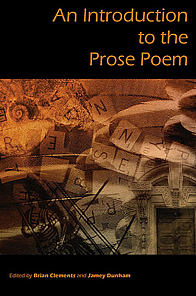
I was introduced to prose poetry several years ago by the wonderful prose poet, Jamey Dunham. I met him in a poetry class I took at Sinclair Community College in Dayton, Ohio. In 2008, Dunham won Salt Publishing, Ltd.’s prestigious Crashaw Prize for emerging poets, for his book of prose poems titled, The Bible of Lost Pets. I have been thinking a lot about prose poems lately and recently had one accepted by a journal. In this post, I decided to share a critical paper that I wrote as a part of my master’s requirement at Ashland University. The paper features an in depth discussion of the Firewheel Editions’ book, An Introduction to Prose Poems, edited by Brian Clemets’ and Jamey Dunham.
The book is a wonderful text on the subject but also, for me, if anything, a delving into the question of what makes a prose poem a poem rather than simply short prose. James Longenbach suggests in his book, The Art of the Poetic Line, from Graywolf Press, that one of the interesting thing about the absence of the “line” in prose poetry is the possibility of its presence.
“The effect of our more typical notion of a prose poem depends on the deletion of lineation from the formal decorum of poetry, the absence of the line would not be interesting if we did not feel the possibility of its presence.”
He goes on to say that in a prose poem (vs. in short prose) there is a release of expectations aroused by narrative logic which to me, is, as Longenbach suggests, the absence of line, as well as, the presense of all the other attributes we commonly associate with poetry–focus on language, tension, surprise, enlightenment. The Prose Poem is so much more–owing partially to its beginnings–than I had originally imagined, as I learned from my research and from An Introduction to the Prose Poem.
As a poet, I find prose poetry more difficult to write effectively and I think I am struggling to learn how to better analyze prose poetry and all the qualities that cause us to step away from it and think, yes, that is a poem. An Introduction to Prose Poetry certainly helps and, if I ever get to teach a class on prose poetry, I will require it as reading for reasons I hope become clear in this post.
A Look at Prose Poetry through
An Introduction to the Prose Poem, edited by Brian Clements and Jamey Dunham
A prose poem should be square as a Picasso pear, or paragraphed like that same pear halved, then halved and halved again—free as air, palpable as an air crash and as final, yet somehow not all there…
–Brooke Horvath, from Definition (289)
In early 2009, Firewheel Editions published a prose poetry anthology titled, An Introduction to the Prose Poem, edited by Brian Clements and Jamey Dunham. What makes the anthology unique is that Clements and Dunham sectioned their anthology into chapters in which they name the specific approach being used by the poets whose work is included in each one. Specifically, there are sections devoted to Anecdote, Object Poems, Central Image/Central Object, Extended/Controlling Metaphor, Meditation, Flash Poems, Aphorism, List Poems, Repetition, Variation or Development of a Theme, Fable, Surreal Imagery/Narrative, Rant, Essayistic, Poems of Address/Epistolary Poems, Monologue, Dialogue, Hybrid Poems, “Free-Line” Poems, Structural Analogues, Abecedarian, Music, Sequence, and Prose Poems about Prose Poems, 24 in all. In some cases, the poems in An Introduction to the Prose Poem could fit into several different categories and the editors acknowledge this where it occurs. However, Clements and Dunham have picked what they feel to be the best category for the overarching direction of each poem.
This new prose poem “taxonomy” is important for two reasons. First, it suggests that the prose poem is not just one type of poem, but rather a sub-genre containing its own set of sub-forms. This endows it with an expanded definition that identifies for the first time the generalization-specialization relationship of poetry in prose form, as having unique, namable branches within it. In other words, the parent form—the prose poem—is elevated by the discovery and classification of the child forms. This feels like something that changes the way we must now reflect upon any specific prose poem. Second, by naming the categories, the editors are creating a framework or a more defined way for us to even consider the poetic options provided by prose poems.
Each section within this text contains a detailed description of why the label has been selected and how the poems within the section fit into that specific grouping. This is helpful because many poets, even well established poets, are not entirely sure what exactly to make of—if anything at all—the prose poem in their own repertoire. Poets, particularly lyrical poets, may tend to discount or even shy away from writing prose poems because of a too narrow understanding of its inclusiveness. For instance, one category is called “Poems of Address/Epistolary Poems,” about which the editors note that “the prose poets tend to look for wide varieties of cultural discourse as models for their poems” (Clements and Dunham 185).
They go on to say that some of the poems by poets in this section (and in most of the sections for that matter), “take bold liberties with the reader’s expectations for the form” (185). Amy Newman’s poem in this chapter is titled “Dear Editor” and begins by innocuously asking the editor of Sentence to review her enclosed poems for publication, but immediately becomes a foray into the letter writer’s mind and experience who, as a child, uses chess as a distraction for illness and isolation and, “. . . as a way of transgressing the nature of the relationship between author and editor” (Clements and Dunham 185). Newman’s surprising digression, in this case her transgression, is classic of many of the poems in the anthology in whatever model they appropriate, poems that cross from the expected to the unexpected.
There is also a poem by William Matthews in this section that is a public address of a declaration of a ‘new regime’ whose motto is: “Love is worth even its own disasters. Its totem is the worm” (192). It is as if Matthews is standing before the microphone of a public address system perfunctorily announcing his message to the gathering.
Also I will be sending out some letters: Dear Friends, Please come to the party for my new life. The dog will meet you at the road, barking, running stiff-legged circles. Pluck one of the burrs and follow him here… (paragraph 3, 192)
In this self-referential passage the poet is appropriating the form of public address in speaking to his readers in much the way a high school principal might address the student body on a PA system, but with surprising content, and to whom? I suggest, not just to the solitary reader, but to the world at large, or at least to anyone within earshot of the PA system.
What resonates in both of these poems is the surprise of the content within the context used by each poet. I believe this is what one could think of as classic prose poem territory: the idea that prose poetry often appropriates commonplace documents in which to insinuate its divergent plot. Michel Delville wrote of this in his book, The American Prose Poem: Poetic Form and the Boundaries of Genre, in referring to the work of poet, Eugene Jolas, and of Transition, a journal edited by Jolas in the late 1930s, that sought out the experimental work of the Surrealists, Dadaist, and Modernists, saying:
What is most remarkable about this particular kind of prose poem is its syntactic regularity which encourages the reader’s expectations of a straightforward narrative line. Yet, despite the persistence of grammatical orthodoxy, Jolas’ prose poem introduces a series of characters and events but refuses to provide them with any definite context. It’s uncanny, surreal quality derives precisely from the tension created between a conventional form and an irrational content. (44)
The idea of divulging such intimate information as feelings about one’s childhood as Newman has done in her letter to the editor, or divulging the exuberance of the poet’s apparent new lease on life over a public address system as Matthews has done in his poem, illustrates Deville’s point perfectly—conventional form with irrational content that gives the work an air of surrealism and surprise.
It’s not just content out of context that creates the character of many of the poems in An Introduction to the Prose Poem. Jorie Graham gets further into this idea in her introduction to The Best American Poetry, 1990, a book she edited that year with David Lehman. In writing about the seven prose poems that were selected for inclusion, Graham noted that
One important formal development is the recent popularity of prose poems. We might think of them as, perhaps, the frontal approach; they are certainly—in many cases—the most extreme in their attempt to use the strategies of “normal” articulate speech to reach the reader. Their number, variety and sheer quality (and the extraordinarily different uses to which the form is put) caused me to think of this volume as, in part, a subterranean exploration of the form. (Graham xxii)
While Deville suggests to us the issue of content out of context in the form, Graham is additionally introducing, the idea that prose poems often adopt what she calls a frontal approach. She suggests that the prose poems are most extreme in their use of common speech—in grammatical orthodoxy. Graham muses on to suggest that, in some ways, that year’s volume of Best American Poems, was in part, a below-the-surface look at the burgeoning form. Time and again, the poems in An Introduction to the Prose Poem reveal this characteristic of possessing language that leans perceptibly and regularly into its content.
In the section called “Monologues” Clements and Dunham suggest that a monologue is a type of soliloquy that may or may not be directed at a specific external audience that “. . . has the dual capability of revealing insight, not only into the subject being discussed by the speaker, but also into the character of the speaker him/herself” (197). That is certainly true of the five poems contained in this section. One can also see that, within these internal conversations, the speaker adopts what Graham has identified as the frontal approach with their language. For example, under the sub-heading of Monologue is a poem titled, “Borges and I” by Jorge Luis Borges and translated by James E. Irby.
The other one, the one called Borges, is the one things happen to. I walk through the streets of Buenos Aires and stop for a moment, perhaps mechanically now, to look at the arch of an entrance hall and the grillwork on the gate; I know Borges from the mail and see his name on a list of professors or in a biographical dictionary. I like hourglasses, maps, eighteenth century typography, the taste of coffee and the prose of Stevenson; …
I do not know which of us has written this page. (202-203)
In this poem, Borges is talking about the disconnected image he has of himself; as seeing himself as someone different than himself and actually observing this other person, “the one things happen to.” “In ‘Borges and I” Jorge Louis Borges uses the monologue to whimsically explore his own fractured understanding of identity. . . .Borges’ poem veils in subtle humor the tension created by the speaker’s awareness that he is not in control. . . ” (Clements/Dunham 197) He then walks the reader through his feelings of detachment even from his writing, saying “. . . but I recognize myself less in his books than in many others or in the laborious strumming of a guitar” (202). This is startling self revelation. Throughout this developing characterization, the poem is replete with the common-place words and colloquialism to which Graham refers, word and phrases such as, “Besides, I am destined to perish, definitely,” “Little by little,” “I like hourglasses, maps, eighteenth century typography, the taste of coffee. . .” These are words and phrases one could hear in a casual conversation with a friend, ones that each of us use frequently.
In the section from the anthology identified as “Dialogue,” Clements and Dunham suggest that “dialogue can be a subtle but extremely efficient device for developing theme or character” (207). Surely, nowhere is colloquial language more prevalent than in dialog so that, not only is it used to develop theme and character as the editors suggest, but it also engages the reader using normal speech, i.e. the speech of conversation, as opposed to the sometimes filigreed and often obscure language of the lyrical. Brian Clements has a poem in this section called “Elephant Date” that “reads like a micro-play, a brief interaction between two characters that uses absurd dialogue and situation to comment on the absurdity of racism” (Clements and Dunham 207). The dialog is between two elephants in a restaurant.
Elephant Date
for Nikki Santilli
Two elephants, Margad
and Nwanda, talk over a
candlelit dinner.
MARGAD
[laughing] …oh, this is priceless!
NWANDA
[chuckling] Yes, I have to admit…
MARGAD
And he never suspected?
NWANDA
No, never! . . . (1-13 212)
Even visually, it is clear what form the poet has appropriated as his poetic approach. It is as if the act of eliminating line breaks (and of liberally appropriating other literary or social forms) brings to the poet a kind of creative liberation. This is perhaps the same liberation experienced by Baudelaire and Rimbaud, often thought to be the earliest masters of the sub-genre. For them it was essentially freedom from the Alexandrine line—strict form and tautness. It gave them a freedom to explore the different, more colloquial voice of the urban landscape as opposed to that of the pastoral that was prevalent at the time, and to adopt a more frontal approach. In short, it allowed them to significantly broaden their creative perspective. Clearly Clements has demonstrated this in his piece that is cloaked in the wrapper of a short screenplay form using everyday dialog in the expression of a poetic project.
Baudelaire and Rimbaud, among other French Symbolists, are often thought of as the fathers of the modern prose poem form. Most prose poem papers and anthologies pay homage, at least in a cursory way, to their role in prose poem’s modern heritage and An Introduction to the Prose Poem is no exception. In his article “Accommodating Commodity: The Prose Poem,” published in the Summer 2000 edition of The Antioch Review, Andrew Zawacki provides a deeper examination of the history of the prose poem, citing examples of what could be considered prose poetry throughout all of recorded literary history (287). This article should be required reading for anyone interested in a more detailed look at the rich history of this sub-genre. Clements and Dunham dedicate a section to the French Symbolists in their introduction. What is equally interesting however, is the introduction and further embedding of the prose poem into the American poetry milieu.
The prose poem underwent a renaissance in the U.S. in the 60’s and 70’s in the hands of poets such as Robert Bly, James Wright, and W.S. Merwin, who wrote prose poems themselves but perhaps more importantly translated the work of the great European and South American prose poets into English. The visibility of the prose poem was promoted by the work of Russell Edson, James Tate, and Charles Simic. By the end of the 70’s the prose poem had caught on as a fairly fashionable mode of writing for American poets. (Clements and Dunham 3)
These are some of America’s most notable poets, poets who have over their writing careers, easily moved back and forth between lined verse and prose poetry. David Lehman in the introduction he wrote for Great American Prose Poems, From Poe to the Present elaborates on what might be considered the uneasy success of the prose poem in the United States. Mark Strand was denied a Pulitzer Prize in 1978 in poetry for his book The Monument, a book of short prose musings on death, because one committee member, “Louis Simpson . . . adamantly opposed the choice. . .” objecting to “The Monument on the grounds that it is predominantly in prose” (Lehman Digital 408-413). It wasn’t until several years later in 1991 that poet, Charles Simic’s author of The World Doesn’t End, would win a Pulitzer Prize for a book of prose poems, thus solidifying a place of prominence for the prose poem in American poetry. Simic’s book captures the bewildering world of a child during World War II in Eastern Europe and, perhaps in a way that lined poetry with its tautness, intellectual obscurity and syntactic acrobatics, never could. It is a book of untitled prose poems that paint an often bizarre picture of life in a war-torn world, in an environment in which not much sense could be made of even day to day survival. The nature of Simic’s material illustrates the characteristics of the early prose poems—the poems of Baudelaire and Rimbaud—described by Rachel Gavin
. . .in terms not only of formal innovation, the tone of ironic detachment, and in the use of a self-conscious speaker but also in its murky atmosphere, representation of human cruelty, and dark humor—channeled from Edgar Allan Poe and Thomas De Quincy—the figure of the alienated flâneur who wanders the city streets, observing the denizens. (48)
One need only to look at the first lines of the two untitled Simic poems, from his prize-winning book that are included in Clements and Dunham’s anthology to understand what Gavin is saying. “I was stolen by the gypsies. My parents stole me right back. Then the gypsies stole me again.” (147) and “We were so poor I had to take the place of the bait in the mousetrap” (148). The editors say of Simic’s poems that “the brief, semi-autobiographical prose poems employ dark, surreal images to capture the strange duality of an immigrant existing in two culture, if not two world, simultaneously” (139-140). The idea of a child being stolen back and forth between parents and gypsies and, being used as bait in a mouse trap because the family is so poor, is at once, absurd and darkly humorous, exemplifying Gavin’s description of early prose poems—an approach not generally thought of as the territory of lyrical poetry.
Clements and Dunham include Simic’s poems under the section titled “Surreal Imagery/Narrative.” They provide a brief description of Surrealism in the chapter heading saying that
When André Breton published his “Manifesto of Surrealism” in 1924, he not only formalized the Surrealist movement but contributed to its becoming one of the central influences not only on the prose poem but on culture in general in the twentieth century. Surrealists wanted to experience or to create the experience in an audience of what Breton called “the marvelous;” they sought to find it in “psychic automatism in its purest state, “in collisions of the dream world and waking life. The effects in poetry were felt in verse and prose alike, but the prose poem was the perfect vessel for the dark, philosophical subtext of Surrealism. Some of the most celebrated contemporary prose poems can be seen to have a foot, if not a leg or two, in the school of Surrealist practice. (139)
Simic’s poems, along with the others in this section, epitomize the “dark, philosophical subtext of Surrealism,” described by the editors. Other poems included under this definition are poems by poets such as Max Jacob, Russell Edson and J. Markus Weekley although, I would argue, a great number of the poems in other sections could fit under this definition as well. Clements and Dunham include in this section, “Ballad of the Carrot Girl” by Mexican poet, Margarito Cuéllar:
She could be a radish, a pore, a chambray onion. She grows in the summer, responding to the call of the sun… And she drifts away, a capital letter, unpunctual, in her Monday afternoon flight. (141)
Even in a translation of the poem, it is easy to think back on Jorie Graham’s description of the prose poem being frontal in its approach and in its characteristic colloquial language illustrated in sentences such as “Many would like to get tangled up in her waist like a happy shrub” (141). Additionally, you can see a wild juxtaposition of images at work. “She could be a radish, a pore, a chambray onion.” The language, and I would suggest the prose form, leads the reader toward an expectation of normalcy, as it casually lays down the unusual imagery in lines like “. . . Does she taste like raspberry gelatin? . . . And she drifts away, a capital letter, unpunctual, in her Monday afternoon flight” (141). The tone is playful, surprising, surreal, and poetic.
An interesting section identified in the book is the one Clements and Dunham call “Structural Analogues.” This section harkens back to their premise that the prose poem “seek[s] out other cultural forms as a kind of template or . . . a set of conventions within which to elaborate a structure” (5). Clements and Dunham hint at the difficulty of narrowing some poems down into just one category because
Many of the other sections in this book are actually subsets of this category. In strategies such as the list poem, aphorism, fable and monologue, the prose poem takes on the structural conventions of other discourses. This strategy is not unique to prose poems. Critic Jonathan Holden has argued that this strategy is characteristic of postmodern American poetry. From this perspective, the recent popularity of the prose poem might be attributable to its very ability to absorb such a wide range of discourses. (233)
Even thinking about Clements’s own poem discussed earlier, “Elephant Date,” one can see how Clements’ has appropriated the conventions of a screenplay. We have looked at poems in which the forms of letters and public addresses were assumed by the poets as creative vessels. In this section there are poems that appropriate the form of post cards (Theo Hummer’s “Moravia: Postcards”), concrete poetry (Gavin Selerie’s “Casement”), a type of instruction manual listing (John Richards’ Ethics Case Book of the American Psychoanalytic Association), cinematographic instruction, (Tom Andrews’ Cinéma Verité: The Death of Alfred, Lord Tennyson) and so on. The assumptions of structural analogues in this section may border on the bizarre but they are also clever, surprising and, by extension, entertaining.
Paul Violi’s poem in this section is a television listing guide, titled “Triptych,” that is presented with times of the day and channel notations giving it the look of the TV Guide listing. However, the lines are thought-provoking phrases, words that present cultural commentary. It starts:
Triptych
——————-
Morning
——————-
6:30 (2) Sunrise
(4) Knowledge
(5) Comparative
Geography. . . (238)
The poem goes on like this over seven pages up to 12:00 midnight, hour by hour, ending with this on channel 11, “FINISHING TOUCHES,/A cloud floats/up to the moon/and stops,/Jolting finale/avoided” (244). Interspersed throughout Violi’s inventive approach are interesting segments of lyrical passage like this installment beginning at 10:30 PM on channel 11: “KARMA,/The live,/leafless/branches/and the dead/tree against the/sky, all/grappling with/the wind” (243). In Violi’s poem, you have surprising form enabling deep lyricism, or in other words, lyrical poetry inside the TV Guide.
Two of the poems in this section, “Fourteen Lines” by Janet Kaplan and “Prose Sonnet to the Silent Father” by Kathleen Kirk, point to the prosody of the sonnet in their approach. Both poems actually number the lines.
Prose Sonnet to the Silent Father
1. I won’t know what to say in my next letter, since you have not answered the last and the one before…
12. I need to learn how to leave silence at the center
13. and still be able to sign my name to it
14. as if it were written by me. (254)
In this case, the appropriation of another cultural form is indeed a given form, the fourteen line sonnet. Kirk numbers her sentences which are in some case more than one line. She gives the piece familiar prose poem colloquial language and includes dialog. Further, Kirk begins by referencing a letter or letters, yet another type of cultural document. There is so much going on in this short span of poetry. Kirk even leaves number seven blank as the representation of the silence she indicates she needs to learn how to leave at the center in item 12 on her list. In this way, she is actually structuring the poem visually to respond to its own admonition to leave silence at the center. If this poem was lined rather than prose, it would likely accomplish this in a much more obscure way, if it could even do so at all. Kirk’s poem—and all of the poems in this section—take risks in the presentation of their poetic project and they stand up as poems aside from their unusual packaging and their quirky approaches. Kirk leaves the reader with much to consider long after the poem has finished, the poem that most surely began with the lump in Kirk’s throat and leaves me with one in mine, as the reader.
In 1874, George Routledge and Sons of London printed a book titled Cobwebs from an Empty Skull, a book of fables penned by Ambrose Bierce under the name of Dod Grile. It is a compilation of pieces Bierce submitted to a weekly journal simply titled Fun. Interestingly, as I read many of the poems in the Fable section from An Introduction to the Prose Poem, I thought of how Bierce’s pieces are precisely the type of work that could have been selected as exemplary for this section. For instance, XCII is the tale of a pig turned human, turned pig, so to speak, from the section in Bierce’s book titled “Fables of Zambri, The Parsee.”
XCIII
A certain magician owned a learned pig, who had lived a cleanly gentlemanly life, achieving great fame, and winning the hearts of all the people. But perceiving he was not happy, the magician, by a process easily explained, did space permit, transformed him into a man. Straightway the creature abandoned his cards, his timepiece, his musical instruments, and all other devices of his profession, and betook him to a pool of mud, wherein he inhumed himself to the tip of his nose.
“Ten minutes ago, “said the magician, reprovingly, “you would have scorned to do an act like that.”
“True,” replied the biped, with a contented grunt; “I was then a learned pig; I am now a learned man.” (61)
This short writing could justifiably be called a prose poem of the Fabulist school as defined by Clements and Dunham, although I am not certain it would have even occurred to Bierce to call it a poem at all. It personifies a pig in a bizarre situation, introduces a darkly humorous twist and reversal when the pig is transformed into a man who begins to behave in a piggish way.
The fable is generally a short fictitious narrative that often, though not always, personifies animals as the central character and usually concludes with a cautionary moral. The fable as it is known today is probably most indebted to the tales of the Greek Aesop. In the United States the form was perhaps best realized in the “Trickster Tales” and other fables passed down orally by the various tribes indigenous to North America. (Clements and Dunham 127)
Many of the poems in this section take on the absurd story persona with the “cautionary moral” as described by Clements and Dunham as being found in Aesop’s Fables. This is also found in the work of Ambrose Bierce as shown above. Ambrose’s tale offers not only social commentary but the caution to be watch what you wish for—or maybe, better to be a cultured pig, than a piggish man. Some take a slightly different approach as does Andrew Michael Roberts’s poem, “Amnesia,” from this section, in which he uses a superhero as the central character that suffers a loss of memory and struggles to find her way in the world while always seeking to recall what special power she possessed.
Amnesia
A superhero awakens, lying wounded in the grass in Conch Park, across from the synagogue. She sits up slowly and looks about, puzzled to find her head throbbing, muscles sore, her multicolored spandex suit ripped and stained. She’s hungry. She can’t remember the last time she ate. Hell, she can’t remember anything. How did I get here? I’m a superhero, surely, but which one? What are my special powers? . . .
It’s on lunch breaks, though, that she sits alone, flipping through comic books—four or five new ones every week—hoping she’ll turn up in the pages, maybe in a scene with Wonder Woman or Green Lantern. And she gets weepy now and then, sipping her chocolate shake, guilt eating her, knowing a train is derailing somewhere, a baby carriage rolling downhill into traffic. . . (130)
Roberts begins by assigning the protagonist superhero status, saying, “A superhero awakens, lying wounded in the grass. . .” From there he casually constructs a life around her that is comedic and sad at the same time: enrolling her in a ‘transitional housing program,’ giving her a job in fast food where she wears ‘brown polyester,’ rises to management and as such is given first choice of vacation times. These elements are introduced as a stark contrast to the superhero status of the woman in the poem, certainly, but to the reader they feel normal because they are mentioned so unceremoniously, almost as an understatement of the reality of the heroine’s situation. Roberts is suggesting through his poem that, within each of us there is a superhero, a person experiencing regret and the loss of a life that has passed us by. And further, don’t so many of the things that make up our daily lives, in the end, take on the element of absurdity, like brown polyester? In many ways, it is easy to overlook the depth of ironic detachment, murky atmospheres and dark humor of many of these poems precisely because of their casual, storytelling approach and frontal speech. These elements are clearly present in Roberts’ poem: the lady that wakes up from who knows what and finds herself in a park, homeless, hungry and then with the help of social agencies, ekes out a living, is able to elevate herself; but, continues to search for the superhero she knows she is and grieves about the good she could be doing in the world but is not. Often the moral lesson, a classic element of fable is obscure and left to the reader’s imagination. Isn’t the moral lesson in Roberts’ piece not to lose oneself, or even perhaps, not to take oneself too seriously.
In Jamey Dunham’s poem from this chapter, “Urban Myth”, that has also been published in Best American Poetry, 2009, a couple gives birth to a lemur.
Urban Myth
A couple awaiting the arrival of their first-born delivers instead a ring-tailed lemur. They are beside themselves. The father beats the obstetrician with clenched fists. He curses the nurses and flings himself to the floor bawling… (136)
Dunham’s new book, The Bible of Lost Pets published by Salt Publishing in 2009, is full of these types of poems—fables are his sub-form of this sub-genre of choice—told in such a casual and logical manner and yet, containing utterly absurd circumstances—content without context—to move it toward its moral, as it were. In this classic Fabulist prose poem approach, the facts appear on the outside to be straightforward in the telling but are often anything but, such as a human couple giving birth to a lemur; and, often the poems finish with a surprise, a twist or with a more explicit moral. Is the moral in Dunham’s poem a reminder that the gratification of child-rearing is often deferred?
Fables, which also embody the classic characteristics of colloquial language and, specifically, the dark humor found in other sub-forms, remains a classic stomping ground for prose poets likely because of the work of one of America’s premier prose poets, Russell Edson. Mark Tursi, poet and a co-editor with Peter Connors, of “Double Room,” an online journal of prose poetry, wrote of Edson’s work:
On the one hand, his work is densely narrative and foregrounds “the telling of a story” and the events of a world in miniature. On the other hand, they exhibit an almost maniacal linguistic journey that is disjointed, fragmentary, and indeterminate. His fable-like tales or prose poems are fantastical and oneiric, yet, in a way, seem to transcend the realm of dreams. . .they present a disjointed phantasmagoric and anecdotal impulse. This gesture of absurdity draws on the unconscious mind in order to poke fun at, as our paranoia, our fears, our joys, our loves, our (false) certainties, and our confusions. (Tursi)
Edson’s disjointed phantasmagoric and anecdotal impulse is evident in his poem “Cloud” from this section which begins with a tale of a man and a woman sitting on their roof. “The husband said, shall we do backward dives, and into windows floating come kissing in a central room” (129)? Edson, because of his tenure in it, remains a leading figure in the Fabulist school of prose poetry inAmerica borrowing from a long tradition of such literature from Aesop to oral narratives of Native America, and I would add, with a heavy dose of absurdity. Might we someday call this approach the Edsonian Prose Poem?
CONCLUSIONS
By stacking these poems into piles of like-minded poems and giving each pile a name that describes the general nature of that pile, Clements and Dunham, have figured out how to eat this elephant—the body of the prose poem sub-genre—one bite at a time. Their approach also raises many questions: Are they correct in this effort? Are the number and definitions of the categories sufficient? Have they created too many categories? Too few? and, perhaps most importantly, does it really matter?
The question of whether or not this effort matters, is critical, particularly when we have repeatedly seen that there are certainly general characteristic among prose poems regardless of the category into which they are placed: the frontal approach, colloquial speech, grammatical orthodoxy, content out of context, detached irony, twists, dark humor, and liberal form-borrowing. I would suggest that it does matter. Somewhere along the way, the sonnet began to be called a sonnet and then a Shakespearian or a Petrarchan or a Spenserian or an envelope sonnet. Literary genres, forms, movements are all named at some point and evolve over time into a common language that opens up new avenues for creative and intellectual discourse. I believe that Clements and Dunham have provided in An Introduction to the Prose Poem, a movement forward in the evolutionary process of shaping the way we think and talk about prose poems. Of course over time the categories will change, expand, narrow or evolve into something else altogether, but it’s a good start. There may be grander prose poem anthologies available—there are many—but, Clements and Dunham have created something that feels very different and very important.
Works Cited
Borges, Jorge Luis, “Borges and I.” Trans. Irby, James E. An Introduction to the Prose Poem. Clements, Brian and Dunham, Jamey, eds.Danbury. CT: Firewheel Editions, 2009.
Clements, Brian and Dunham, eds. An Introduction to the Prose Poem.Danbury. CT: Firewheel Editions. 2009.
Cuéllar, Margarito. “Ballad of the Carrot Girl.” Trans. Stewart, Steven J. An Introduction to the Prose Poem.Danbury. CT: Firewheel Editions, 2009.
Delville, Michel. The American Prose Poem: Poetic Form and the Boundaries of Genre.
Gainesville, Fl: The University Press ofFlorida, 1989.
Dunham, Jamey. “Urban Myth.” An Introduction to the Prose Poem. Clements, Bria n and Dunham, Jamey, eds.Danbury. CT: Firewheel Editions, 2009.
Gavin, Rachel. “Neither Heads nor Tails.” “World Literature Today.” September-December, 2004. 46.
Graham, Jorie. “Introduction.” The Best American Poetry, 1990. Graham, Jorie, ed. Lehman, David, series ed.New York: Scribner, 1990.
Grile, Dod. Cobwebs from An Empty Skull. London: George Rutledge and Sons: 1874.
Horvath, Brooke, “Definition.” An Introduction to the Prose Poem. Clements, Brian and Dunham, Jamey, eds.Danbury. CT: Firewheel Editions, 2009.
Kirk, Kathleen. “Prose Sonnet to the Silent Father.” An Introduction to the Prose Poem. Clements, Brian and Dunham, Jamey, eds.Danbury. CT: Firewheel Editions, 2009.
Lehman, David. Introduction. Great American Prose Poems, From Poe to the Present. Ed. David Lehman.New York: Scribner Poetry., 2003. Kindle v. 2.0.3.
Mathews, William, “Attention Everyone.” An Introduction to the Prose Poem. Clements, Brian and Dunham, Jamey, eds.Danbury. CT: Firewheel Editions, 2009.
Roberts, Andrew Michael. “Amnesia.” An Introduction to the Prose Poem. Clements, Brian and Dunham, Jamey, eds.Danbury. CT: Firewheel Editions, 2009/
Simic, Charles. from “The World Doesn’t End.” An Introduction to the Prose Poem. Clements, Brian and Dunham, eds.Danbury. CT: Firewheel Editions, 2009.
Tate, James. The Lost Pilot. “James Tate and American Surrealism.” Gioia, Dana. A radio review of James Tate’s Selected Poems originally broadcast on BBC Radio 3, printed in “Denver Quarterly”, Fall, 1998. Nov. 6, 2009. <http://www.danagioia.net/essays/etate.htm.>
Tursi, Mark. An Interview with Russell Edson. “Double Room.” Issue #4, Spring/Summer, 2004. Oct. 5, 2009. <http://www.webdelsol.com/Double_Room/issue_four/Russell_Edson.html.>
Violi, Paul. “Triptych.” An Introduction to the Prose Poem. Clements, Brian and Dunham, eds.Danbury. CT: Firewheel Editions, 2009.
Zawacki, Andrew. “Accommodating Commodity: The Prose Poem.” “TheAntiochReview.” Volume 58, No. 3, Summer, 2009. 287.
© 2010-2012 Grace Curtis
 A book of poetry I enjoy so much and go back to often is Larry Levis’ Winter Stars. From the first moment I read it, I was drawn into the beauty of the poems and into their honesty. There is a candidness in discovery and exposure, as the poems in Winter Stars explore topics of loss, wonderment, spirituality, coming of age, the search for the soul, and others, that spin around the complexities of being human. It is a book I refuse to overly examine with a critic’s eye and one that I will always look at first, as a lover of poetry and as a human being.



 N2 Poetry